El Salvador’s plans for a new city dedicated to Bitcoin, and push to make the cryptocurrency legal tender, only benefit an ultra-wealthy libertarian elite
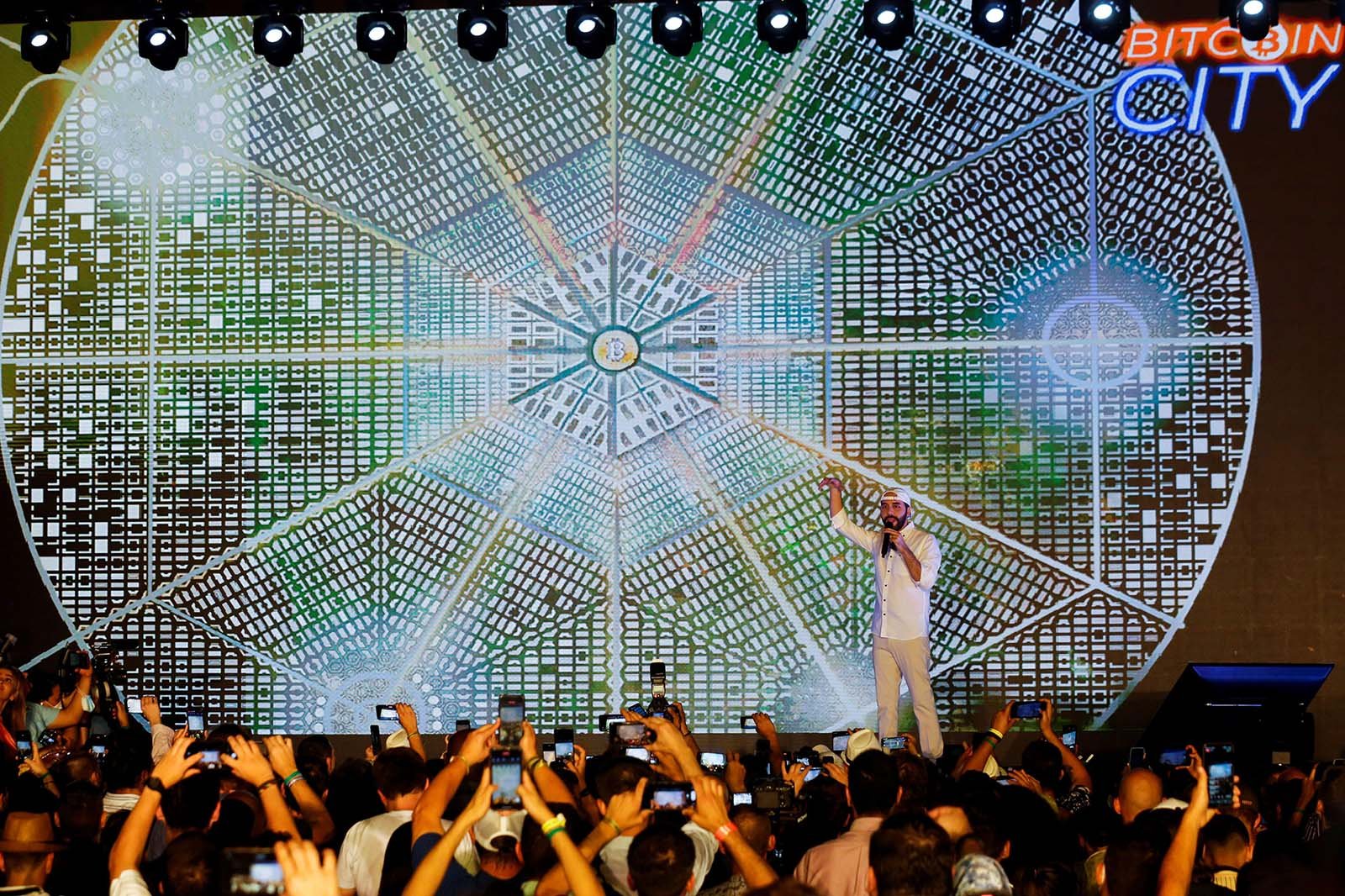
In November 2021, president Nayib Bukele invited Bitcoin enthusiasts from around the world to El Salvador. Months earlier, Bukele’s government had quickly passed the ‘Bitcoin Law’ to make cryptocurrency legal tender alongside the US dollar. It was his opportunity to make a big announcement. Bukele wasn’t content simply trying to force Salvadorans to use Bitcoin; he also wanted to build a new municipality in the south of the country to attract crypto companies. It would be called Bitcoin City.
Bukele pitched a technolibertarian paradise to the foreign attendees: a city with no income tax, no capital gains tax, no payroll tax, not even property tax. It would be ‘committed to free and equal access to everything’, yet corporations and the wealthy would be let off the hook while funding would supposedly be provided solely through a 10 per cent value‑added tax: only half of this would be spent on city services and half would pay back the bonds required to build it. The city would be in the shape of a circle with a main square centred around a Bitcoin symbol, with a break along the outer boundary to accommodate the volcano that would generate geothermal energy to power the city and energy‑intensive Bitcoin mining operations. Crypto mining has been responsible for power outages in some countries, and a study published in February suggests its carbon footprint has increased by 17 per cent since mining was banned in China. Bukele asserts that using power from El Salvador’s volcanoes can change that, but crypto critic David Gerard has pointed out that the country’s energy rates are more than double the global average price of power for Bitcoin mining, and an existing operation at the geothermal plant in Berlin has been known to burn more energy than it recoups in Bitcoin.
In short, Bukele pitched an ecological smart city with few taxes but full equality. He termed it the ‘Singapore of Latin America’ – surely trying to reference its attractiveness for business, not to draw attention to his own authoritarian turn. While using crypto as the central framing may be novel, Bitcoin City joins a long list of proposed new cities that were supposed to deliver economic miracles and technological marvels that failed to materialise. There is little reason to believe Bukele’s play to win the hearts – and open the wallets – of Bitcoin enthusiasts will be any different.
Over the past couple of decades, more than a hundred new city projects have been proposed in the Global South with all manner of utopian claims attached to them. Sarah Moser, a professor of urban geography at McGill University, argues that they do not tend to deliver the promised benefits. She explains that these projects are ‘often targeted at elites’, with housing that is not even affordable to the local middle class: ‘it seems to be that we’re creating massive, gated enclaves on an unprecedented scale’.
These projects seek to take advantage of rising real estate values and how housing has firmly become an asset class rather than a place of residence. But as the tech industry’s importance to the global economy has grown over the past decade, it has also become central to these projects. ‘The majority of the cities today are fuelled by corporations, and these corporations see unprecedented opportunities to make money,’ says Moser. ‘IBM, Cisco, Google, Microsoft, they’re all in the new cities game now.’
For example, Masdar City in the United Arab Emirates and Songdo in South Korea promised to show the world the future of sustainable, ‘smart’ living. Masdar City was to be a green pedestrian paradise where no one would drive, but instead use a ‘personal rapid transit’ system of driverless pods, yet its walkable streets are devoid of people and its transport ambitions have been scaled back to the point where the city itself is only accessible by car. Meanwhile, Songdo allows residents to dispose of rubbish through pneumatic tubes, and its apartments had smart‑home capabilities earlier than most, but residents complain that the city itself feels cold: technology is everywhere, but it’s missing the human element.
‘Extreme libertarians wish to evade the state altogether, which is the promise they see in cryptocurrencies and the possibility of creating a stateless financial system’
While those projects have advanced thanks to government commitments, others like Konza City in Kenya are more typical of how they tend to play out. The development was supposed to bring investment, create thousands of jobs and become a global tech hub in Africa, but beyond a few notable buildings, there is little to show and it seems unlikely to ever reach that stage. Even as the projects have failed to live up to their ambitions, the legal structures around them, particularly their frequent placement in deregulated special economic zones, have caught the attention of wealthy investors.
Libertarians have long been looking for ways to opt out of society and escape the authority of states, and powerful people in Silicon Valley have been active participants in that effort. Previously, seasteading seemed to be the route to achieve these goals: its supporters wanted to use cruise ships or oil platforms to create communities in international waters where they would be beyond state jurisdiction. For a time, venture capitalist Peter Thiel funded the Seasteading Institute, but has since pivoted into a vigorous embrace of Bitcoin, as its potential to break state control over money forms part of a broader vision of using digital technologies to create alternative governance structures.
Over the past decade, we have seen various countries begin to offer non‑citizens (specifically, foreign investors) the means to start businesses and access other services through virtual means without physical residency, the most notable of which is Estonia’s e‑Residency programme. Wealthy people will occasionally take advantage of those initiatives, but some more extreme libertarians wish to go beyond that and evade the state altogether, which is the promise they see in cryptocurrencies and the possibility of creating a stateless financial system. As these powerful individuals seek to evade existing political structures, they have shifted their interest from international waters to deregulated spaces where they are granted exclusions from state authority and investors get to write the laws.
Central America has proven to be a key area of focus for these city projects. In 2013, Honduras passed a law allowing private cities in special economic zones – seemingly building on the new cities trend from the previous decade after its initiative to allow charter cities failed. But the product of that law is wealthy libertarians buying up land in the country, imposing their will on the local population, and envisioning a world where cities compete on taxation, regulation and services to attract residents without the acknowledgement that only a small sliver of the world’s wealthiest can make that choice.
In Bukele’s announcement, he likened his crypto capital to the 20 cities of Alexandria founded by Alexander the Great. He called them ‘beacons of hope for the rest of the world’. El Salvador’s Bitcoin City would be the first of many, but he seems to have spoken too soon. Even during Bitcoin Week, the cryptocurrency’s price was already falling from its high of nearly US$70,000. By January, its value was virtually half of that. El Salvador’s experiment is in trouble, with few Salvadorans using it and the Central American University finding that more than 70 per cent of the public have little to no trust in Bitcoin and see it as something that benefits foreigners. The declining price has caused interest in crypto and related products to plummet.
The US$1 billion ‘volcano bond’ that Bukele said would fund the project was supposed to launch in mid‑March, but it has been delayed as questions mount about its feasibility. The promised 6.5 per cent rate is much lower than the yield on El Salvador’s sovereign debt, and it will be issued by the country’s thermal energy company instead of the government. It is also intended to be issued through Bitfinex, a platform on which Americans are banned from trading, limiting potential investors.
‘El Salvador’s experiment is in trouble, with few Salvadorans using it and the Central American University finding that more than 70 per cent of the public have little to no trust in Bitcoin’
Rather than an innovative urban experiment, Bitcoin City is the latest in a long line of failed projects that previous Salvadoran governments have tried to launch on the same site. In 2017, it was a plan for a charter city based on the Honduran model with the backing of US libertarians, while in 2018 it was one built by China that Bukele himself slammed as ‘the most neoliberal project proposed by a government in the history of our country’.
Bitcoin City is the culmination of trends that incentivise private cities built for investors and the prospect of digital technologies to allow them to set up structures that further enhance their power over the rest of us. The project is a warning of the dystopian future that libertarian billionaires and their followers are trying to build. In this case, it appears that effort will fail, but it does not mean they will not try to set their libertarian Alexandria down somewhere else in the years to come.