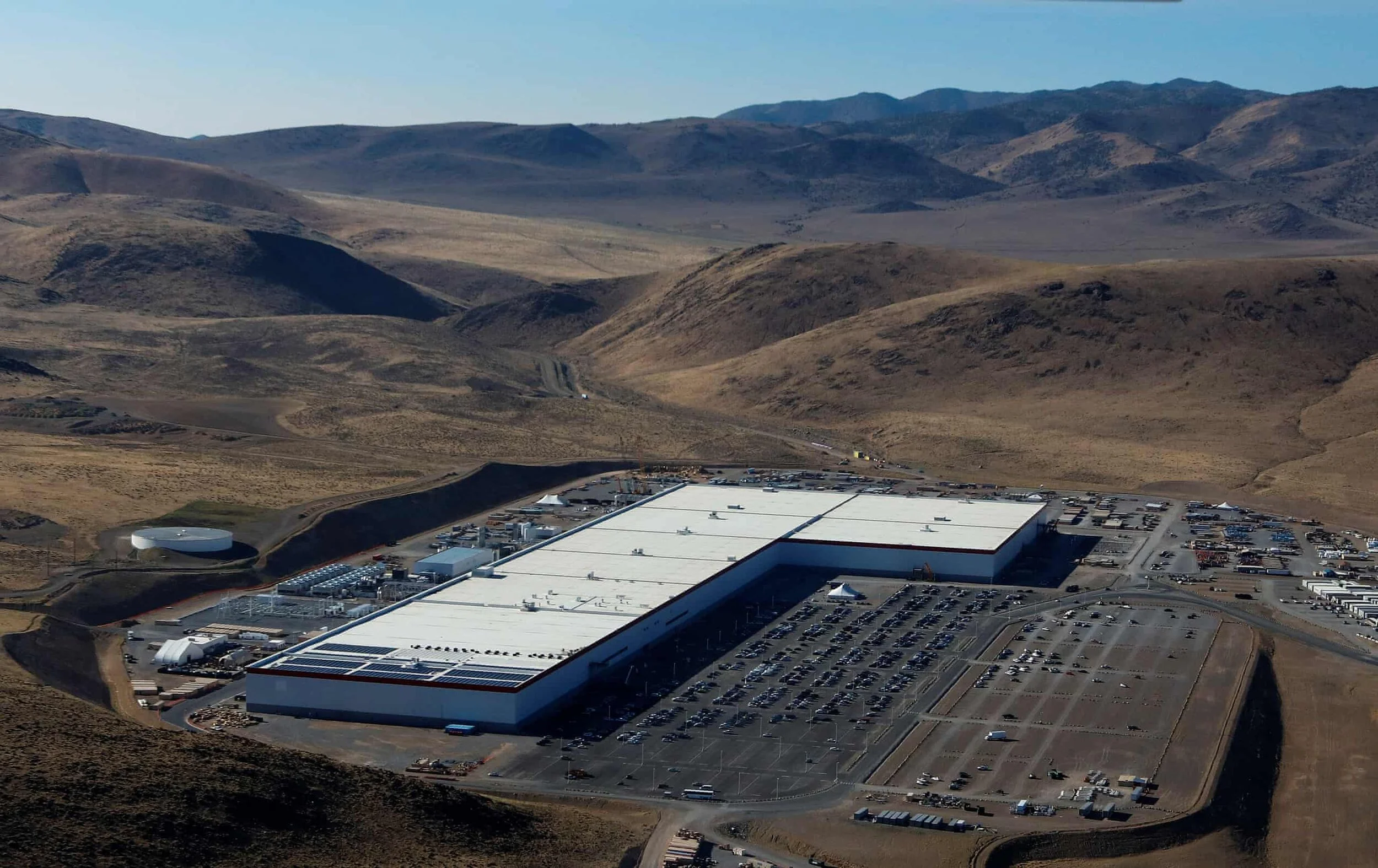
‘Its boredom is hypnotic, its banality breathtaking’ … the world’s largest building, the Tesla Gigafactory, embodies the new architecture.
'The countryside is where the radical changes are': Rem Koolhaas goes rural
It was while visiting a brothel on the outskirts of Reno, Nevada, that Rem Koolhaas had his latest epiphany. The Dutch architect was there to meet Lance Gilman, the cowboy hat-wearing proprietor of the Mustang Ranch bordello who is the unlikely visionary behind some of the planet’s largest yet least known buildings. What Koolhaas saw that day would radically alter his thinking on the future of architecture.
A short drive from the heart-shaped swimming pools and red faux crocodile-skin furniture of Gilman’s office in the adult resort, a strange apparition of enormous white rectangles appeared in the desert. “It is a fantastically beautiful landscape,” says Koolhaas, “with rolling hills and wild horses. And in the middle of it all were these colossal structures, placed in a way that didn’t seem to suggest any coherence or sign of human inhabitation.”
If you look at the area on Google Earth, these blocks appear like large chalky fields, or the salt evaporation pools of a lithium mine. But they are mines of a different kind: vast industrial sheds housing the technology behind the blockchain, the cloud, and the future of electric vehicles.
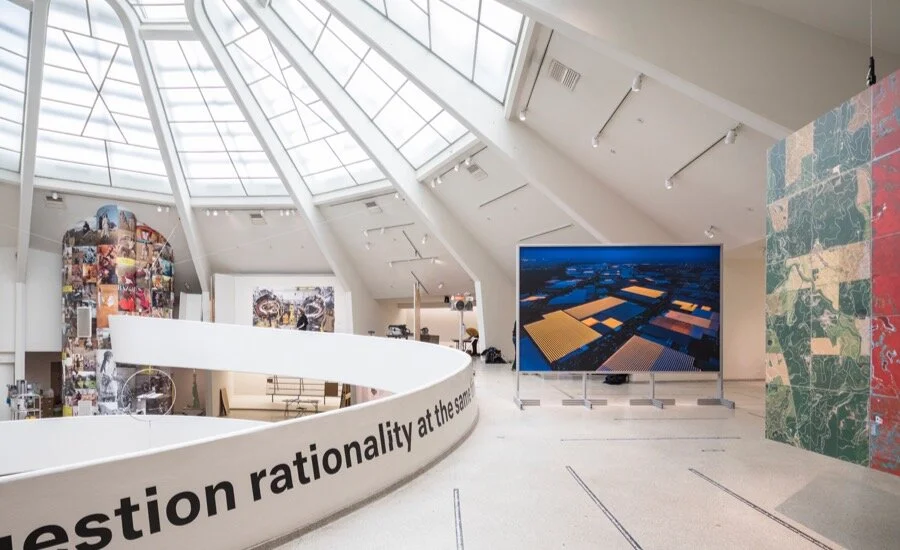
This is the Tahoe Reno Industrial Center (TRIC), the largest industrial park in the world, a 107,000-acre swath of the Nevada desert that has become the backroom for Silicon Valley’s big tech companies, lured here by the favourable tax regime and instant building permits. Gilman bought the land for $20m in 1998 from Gulf Oil, which had planned to fill it with big game and turn it into a luxury hunting reserve. Gilman quickly had it zoned for industrial use, and the big boxes have sprung up like rectangular fungi after rain. It is now home to gargantuan hangars for Google and Apple, along with distribution warehouses for businesses such as Walmart and Amazon, and the new Tesla battery “Gigafactory” – set to be, at 1m sq metres, the world’s biggest building when finally complete.
“There has been no architecture of a similar vigour in the last 100 years,” he writes in an ode to the sheds. “It is based strictly on codes, algorithms, technologies, engineering and performance, not intention. Its boredom is hypnotic, its banality breathtaking.” For Koolhaas, these buildings embody a new kind of sublime.
A pair of 12ft-high photographs of the data centres now hang on the top floor of the Guggenheim Museum in New York, occupying the final level of a sprawling exhibition, momentously titled Countryside, The Future, set to open next week. Five years in the making, and drawing on a decade of research undertaken by his team at AMO (the “thinktank” of Koolhaas’s practice, the Office for Metropolitan Architecture, or OMA) and armies of volunteer students, the scope of the show is nothing if not ambitious.
“We decided to focus on the 98% of the Earth’s surface that is not occupied by cities,” says Koolhaas, casually, as if the prospect were like any other design brief. “At a certain point, the UN declared that half of mankind is now living in cities, since when there has been an avalanche of books and biennales talking only about cities. As a result, there is an enormous deficit in understanding what is happening in the countryside, which is where the truly radical changes are taking place.”
“I'm interested in the country for the same reason I was paying attention to New York in the 70s. No one else was looking”
- Rem Koolhaas
But now the rest of the world has caught up and the urban obsession has taken over, the self-styled contrarian has had to move on. “I am interested in the countryside now for the same reason that I was paying attention to New York in the 70s,” Koolhaas says. “Because no one else was looking.”
His interest in rural transformation was first piqued by changes that he noticed in a Swiss village in the Engadin valley, where he had holidayed for years. The area’s population was decreasing, yet the village was expanding, with an ever-increasing number of holiday homes and a new demographic: urbanites seeking wellness, accompanied by a transitory community of south Asian housemaids. These discoveries prompted Koolhaas to survey a chunk of the Dutch countryside, where he found farmers diversifying alongside an influx of wealthy city-dwellers wanting to sample life in the country, “attracted by the aura of authenticity”.
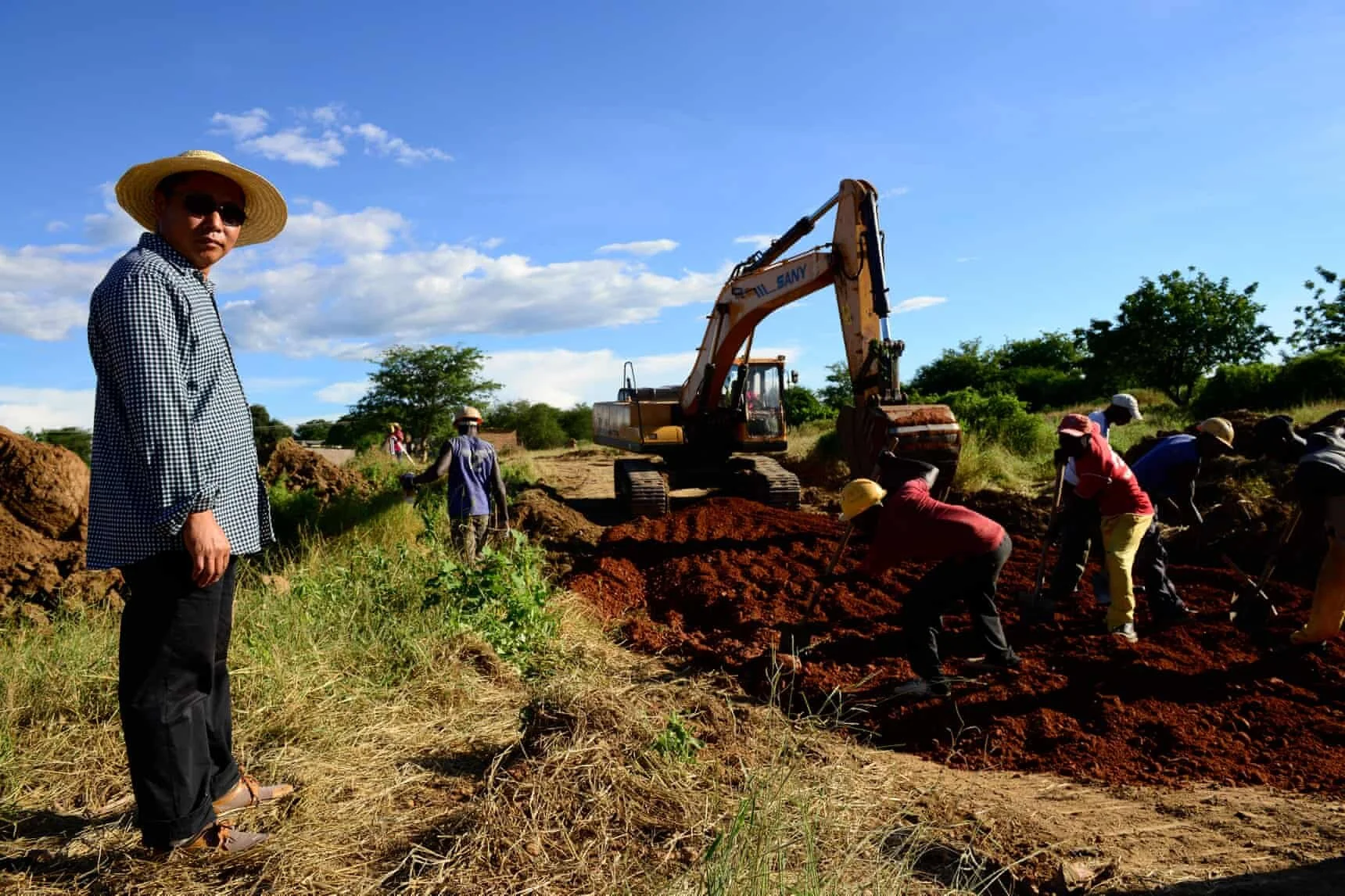
Transforming Africa … a Chinese-led construction project in Zambia. Photograph: Joerg Boethling/Alamy Stock Photo
“We started to find deeply absurd conditions,” he says. The more he looked, the more he started to see the global countryside as an enormous canvas on which anything too large, complex or unsafe to blend with urban life takes place. “A world formerly dictated by the seasons and the organisation of agriculture,” he writes, “is now a toxic mix of genetic experiment, science, industrial nostalgia, seasonal immigration, territorial buying sprees, massive subsidies, incidental inhabitation, tax incentives, investment, political turmoil – in other words more volatile than the most accelerated city.” While we were all concentrating on cities, he argues, the next revolution was forging ahead in the hinterland, undisturbed.
There is a naivety to how Koolhaas recounts some of these revelations, which suggests a sheltered urbanite whose musings on rural life are as ill-fitting as muddy wellies in his Prada wardrobe. Yet much of the strength of his work has come from approaching topics as an innocent outsider. One mentor from his early life as a journalist, before he moved into architecture, told him to treat every situation as if he was a Martian new to Earth. It can be a compelling style of writing, but will this detached observer’s deadpan study of disparate rural phenomena translate into a meaningful exhibition?

The sense that this is no ordinary Guggenheim show will begin before you enter the building. Visitors will be greeted by a gigantic hi-tech tractor, capable of being controlled from an iPad, parked on the pavement next to a large module growing tomatoes under pink light: objects from the digitised frontline of agriculture brought back to the city.
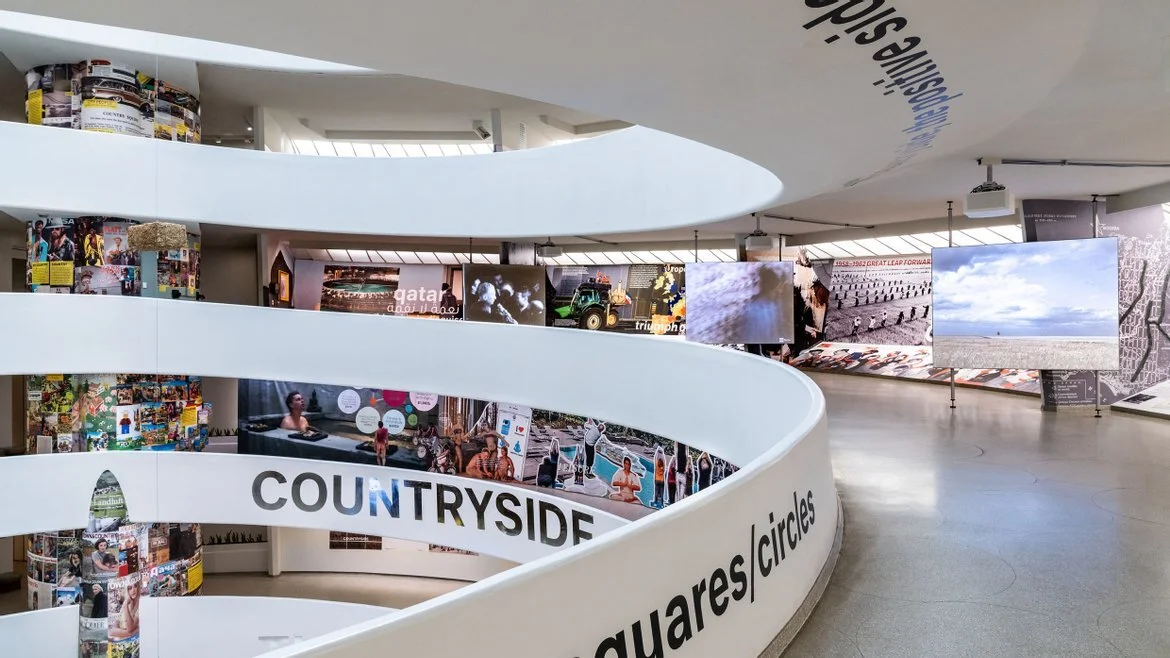
In a manner reminiscent of the architect Philip Johnson’s seminal Machine Art show in 1934 at New York’s Museum of Modern Art (which placed utilitarian, industrially manufactured objects in a museum setting for the first time) visitors will encounter a satellite dangling in the atrium, along with a big bale of hay and an underwater drone designed to patrol coral reefs. From here, the rotunda spiral will extend upwards in a continuous stream of consciousness, with sections on leisure, politics, preservation, agricultural automation and numerous other facets of rural existence that have preoccupied the busy Dutchman and his extensive cast of collaborators.
“It is a total panoply of voices and themes, cutting across space and time in a really unconventional way,” says Guggenheim curator Troy Conrad Therrien. “It abandons the usual museological preciousness of classification and creates juxtapositions intended to make people think.”
The list of themes reads like the contents page of National Geographic crossed with Wired. It includes the countryside as a cradle of culture in ancient China and Rome; how dictators from Stalin to Mao have left their mark on the land; the ways that Chinese investment is transforming chunks of Africa; how refugees have been housed in abandoned towns in eastern Germany; how gorillas are interacting with tourists in the Congo; the impact of thawing permafrost in Siberia; technological change in American midwest farms. The list goes on. They sound like fascinating, urgent stories, but it is hard to see how they might form a coherent narrative. And what has it all got to do with architecture?
“It has nothing to do with architecture,” Koolhaas admits. “It is more anthropological and sociological. I find it exciting that an art institution would dedicate so much space to something that is not art or architecture.” Therrien describes it as a “pointillist portrait of a mutating territory”, a show about curiosity and questioning rather than providing answers. “Will it feel overwhelming to the visitor? Yes.” Might it feel colonialist and out of touch? Maybe. “We haven’t tried to put a wokeness veneer over the show,” he says. “In the age of outrage, there are some things that people might take out of context and create a hurricane around, but they are what they are.”
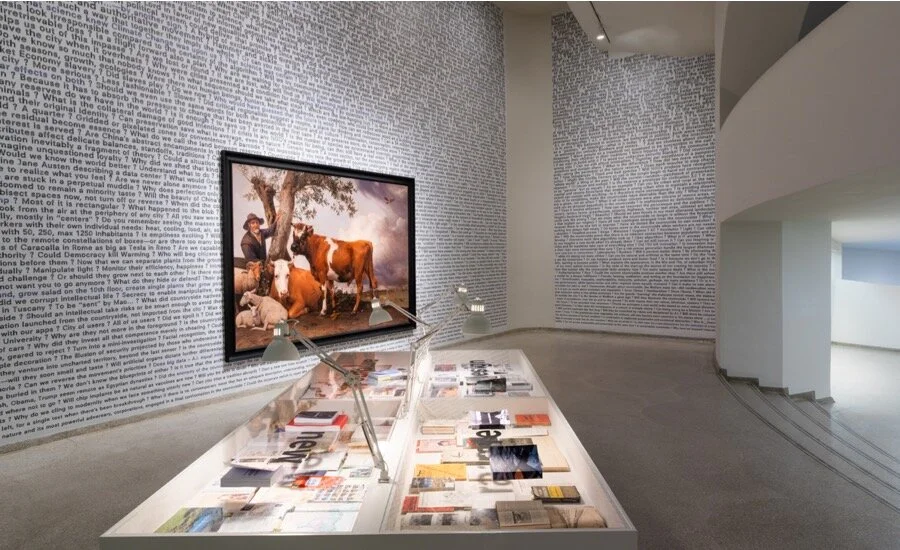
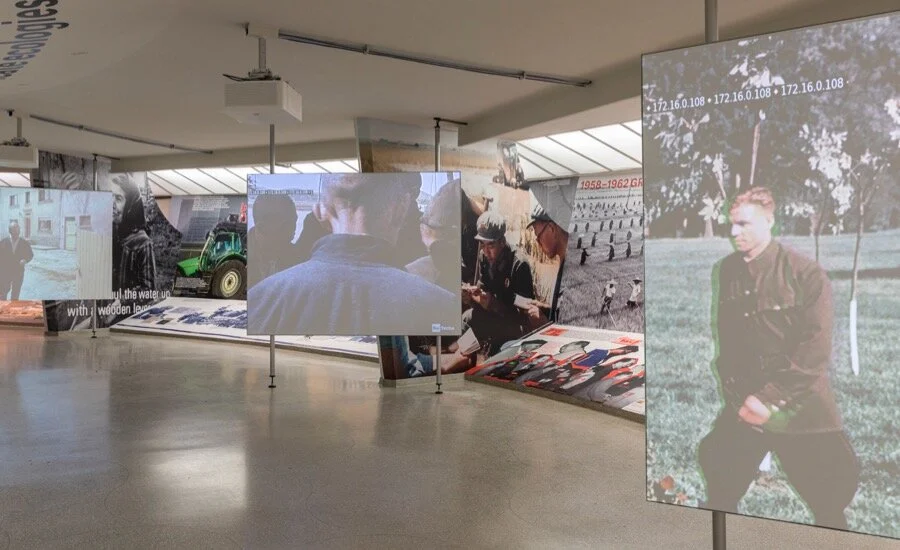
There is a tendency for “research-led” architectural exhibitions to end up feeling like a book stuck to the wall, and there is a danger the Guggenheim exhibition could fall into that trap. Therrien says that text will be a big part of the show, along with huge printed curtains and long ribbons of wallpaper that will wrap around many of the walls, with video screens showing documentary footage. There will also be a handful of roving robots, of the kind used in fulfilment centres, adorned with styrofoam cutouts intended to “constantly throw the curatorial ball up in the air”.
“Koolhaas's attraction to ultra-utilitarian mega-sheds in the industrial hinterland is because they have nothing to do with architects.”
ome who were involved in the project fear Koolhaas might have finally bitten off more than he can chew. “It’s problematic to call it ‘research’,” says Charlotte Leib, a doctoral student at Yale, who was part of the exhibition’s team when she was studying at Harvard. “There are thousands of experts in these fields, and some of them were contacted, but it was a process of sculpting their findings towards the worldview of Rem.” Another research assistant is frank: “It’s symptomatic of architectural hubris that they take snapshots of a topic like this and present it to the world as ‘new’.”
So what does Koolhaas want visitors to take away from his grand rural ramble? “I’ve always tried to put relevant issues on the architecture agenda,” he says. “I am not thinking there should be more planning of the countryside, or that it is the next big place for architects to intervene.” His attraction to the megastructures of the industrialised hinterland is precisely because they have nothing to do with architects. They are ultra-utilitarian sheds, divorced from architectural ambition.
“There is a danger of Midas in reverse, in terms of the consequences of architectural attention suddenly shifting to phenomena that were being developed innocently on their own,” he says. “But I think it’s more likely that architecture will change as a result of what’s happening outside cities, rather than architects spoiling this new field.”
Koolhaas says his own practice has already been influenced by what he calls the “post-human” architecture of the colossal sheds at TRIC and elsewhere, which he sees as embodying a kind of unparalleled purity. “We are programmed to think that any ‘next’ architecture can only be the outcome of a struggle,” he writes, in an exhibition catalogue essay. “Modernism was born in a relentless campaign of stripping: of ornament, bourgeois values, frivolity. Because it takes place in the countryside, this is a stealth revolution … The buildings here are not for humans but for things and machines. Thousands of years of architectural and cultural history are ditched.”
He describes OMA’s new performing arts centre in Taipei, still under construction, as a result of this logic – “halfway between a building for humans and machinery”. It incorporates a huge amount of back-of-house space for scenery and mechanisms to transform the auditoria in multiple configurations. The Factory, a new £130m venue being designed for Manchester, looks distinctly shed-like, and one wonders if OMA might be taking the “post-human” idea a bit too literally, judging by the blank street frontage of its recent building for Brighton College.
Koolhaas’s exit from the city comes at a time when he seems increasingly detached from the built output of his practice. He keeps his own separate office in Amsterdam, away from the 300-strong team in Rotterdam, where he can concentrate away from the hubbub. There has been a restructuring of the partnership, so he is no longer the dominant overseeing principal, and OMA’s buildings are now credited to the individual partners. He rarely attends the openings. Is this epic exhibition his swan song before quitting architecture?
“Am I going to retire?” he barks, incredulously, before changing the subject to a new kind of tractor.
Written by Oliver Wainwright. Published by the Guardian 2/11/20.
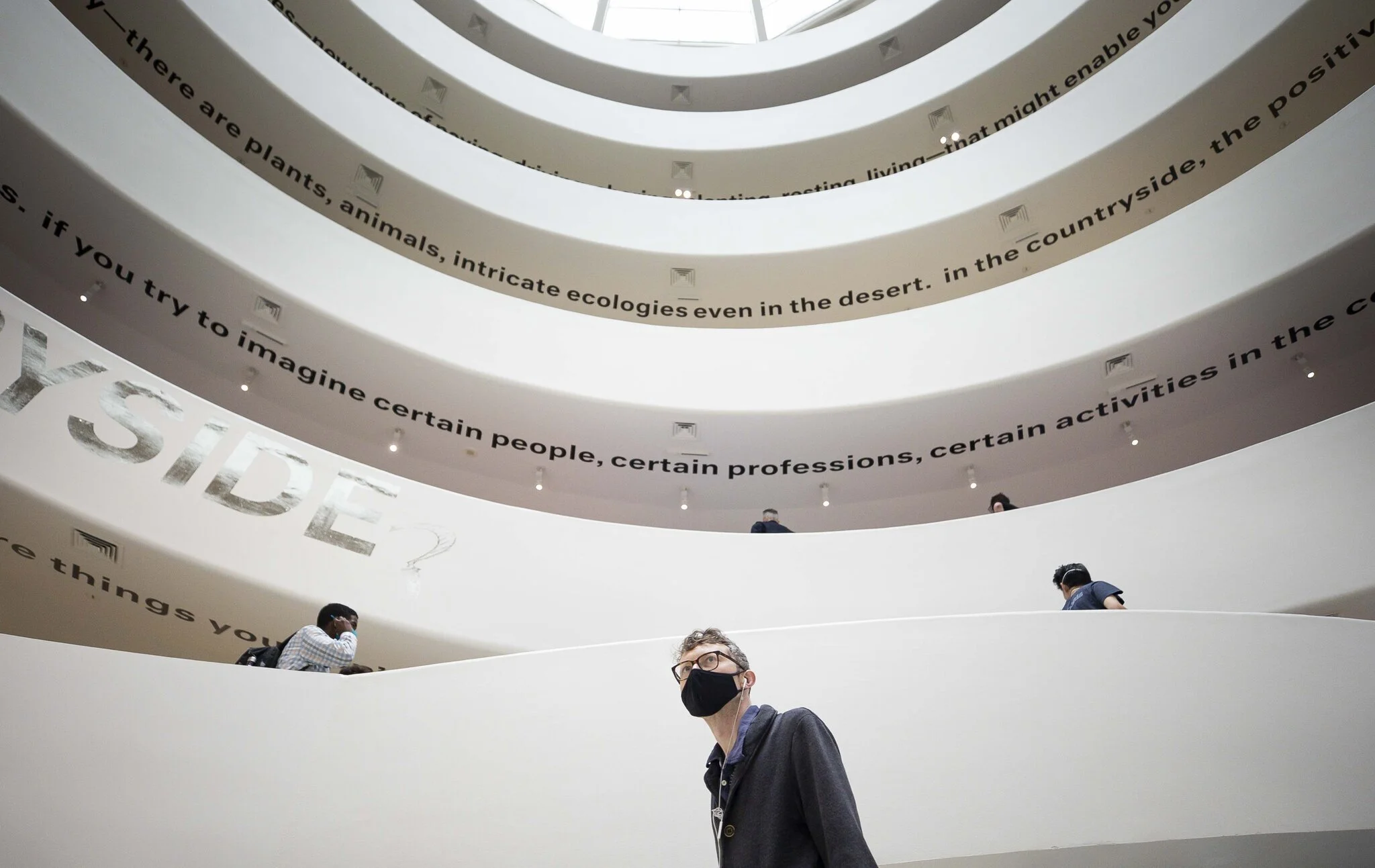
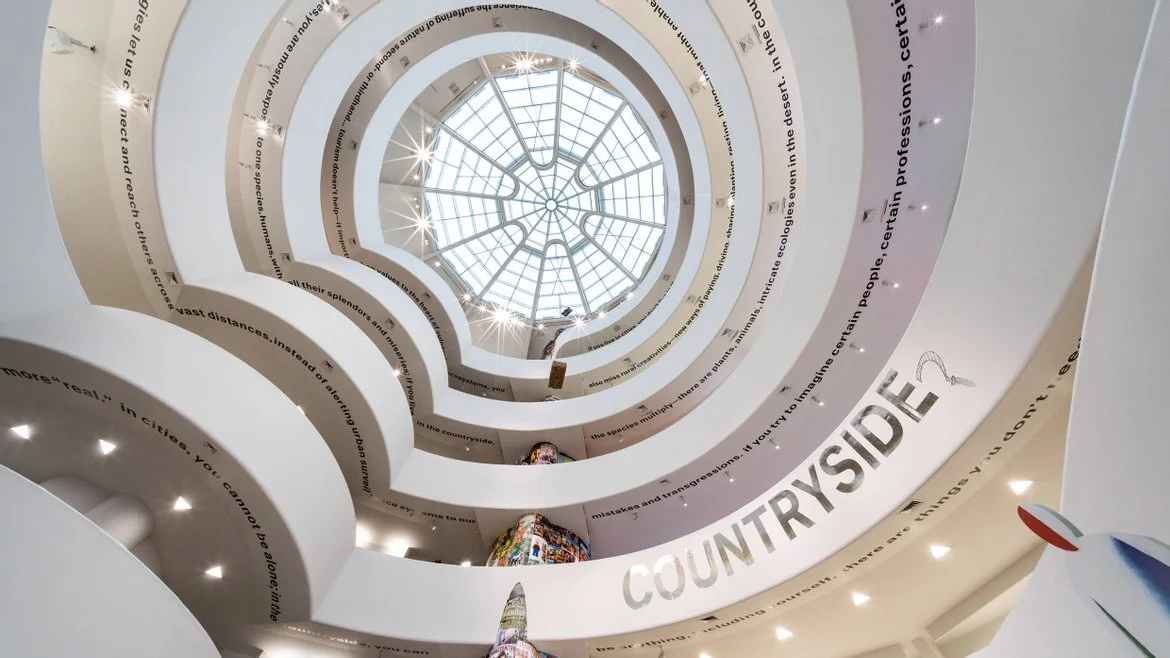
As Rem Koolhaas explains in the introduction to this exhibition, over the last 20 years he had noticed changes in a Swiss village he often visited. In a “Rem” van Winkle mode he seemed to awaken finally to find his pastoral retreat despoiled: First it was finding a bad post-modern addition to a beloved old barn. Then it was the discovery of a charming 1909 photograph of Russian peasant farmers along with another of the alienating, red-lit space of a contemporary Dutch greenhouse growing tomatoes. He wonders “What happened?”
Highly energized, Rem summons trusty students at the Harvard Graduate School of Design; the Central Academy of Fine Arts, Beijing; Wageningen University, Netherlands; and the University of Nairobi. Working with lots of live ammo from AMO (the research group of his Office for Metropolitan Architecture), his posse takes off to four continents; north, south, east, and west, to study ways to save Mother Earth.
The result is a torrent of words, images, and artifacts—including farmer Barbie dolls—unspooled along the great Guggenheim ramp on the walls, floors and ceilings. Don’t expect any conclusions or answers, since Rem and team struggled mightily, Laocoon-like with the material, ultimately drowning in the writhing serpents of data. In a time when statistics indicate that most people occupy cities, Koolhaas seeks “to construct a composite picture of the current condition of ‘countryside’—a glaringly inadequate term for all the territory that is not urban.”
This hot mess of a show is at once provocative, fascinating, enraging, disturbing, barely hopeful, and contradictory. Signage is inscribed on both the ribbon-like parapets and walls of Frank Lloyd Wright’s rotunda evoking Jenny Holzer’s digital art or a Bloomberg financial display. But for a show that presents itself as research and reportage, it has curious lacunae in its historical perspective and contemporary context. For example, global warming is dealt peripherally with examples such as the melting Siberian permafrost. But is not given its own section, even though it is the single most important issue confronting the “countryside” now and in the future.
The exhibition starts off auspiciously enough with a discussion of two ancient concepts of the countryside, the Roman otium or leisure, and a similar idea in China of xiaoyao. Then in rapid succession, we skip to Marie Antoinette’s notorious hameau, where she could pretend to be a shepherdess, and on to 1960s hippies, then to the current boom in the wellness industry.
All hell breaks loose in the political section. Here we are confronted by a newly constructed photoshopped collage on a curving wall of “the future of the world prepared in smoke-filled rooms by mostly white men…” Sitting at a desk between Hitler and Stalin is Franklin D. Roosevelt—implying some sort of a collaboration or affinity. Then we are treated to the 19th-century thinker Charles Fourier and his Phalanstery as a utopian community in the countryside. Along come the grand projets of the twentieth century: the most fascinating of which is Atlantropa, a German engineer’s idea to dam the straits of Gibraltar, draining the Mediterranean to connect Europe with Africa and irrigate the Sahara. Needless to say, it got nowhere, but this is the scale of a project Koolhaas admires.
Hitler's autobahn appears as part of his "Blood and Soil" German countryside renewal along with Stalin’s and subsequent Soviet leaders attempts to reverse Siberian rivers to create more farmland. The United States section notes the imposition of the Cartesian grid by Jefferson across the west irrespective of geography or Native American lands. Abraham Lincoln is cast as the villainous author of the 1862 Homestead Act, selling off indigenous lands to white settlers. On the other hand, Mao Tse -Tung’s “Great Leap Forward” in China, an agricultural revolution and staggering failure that resulted in tens of millions of deaths by starvation, is noted merely as a “harsh modernization campaign.” The “Cultural Revolution” an internal Maoist purge, destroying libraries, closing schools and universities, burning books, killing as many as two million, and ruining the economy, is described by Koolhaas as a “true disruption” as if it were a positive way of describing a new Silicon Valley product. Whoa.
Happy Chinese people propaganda posters are presented uncritically and there is even a rural village council setting installed on the ramp as it were representative of a New England town hall. China comes off quite favorably in Rem’s treatment of the countryside. Perhaps he admires the Chinese system where there is, let’s say, no community involvement to slow down projects.
The African countryside is noted mainly as the beneficiary of Chinese largesse in the presently suspect “Belt and Road” initiative, without mention of the Kenyan artist Michael Soi’s critical “China Loves Africa” series. A curiously large section is devoted to the endangered gorillas of Uganda, the Congo, and their interaction with local villagers as well as tourists. Overheard on the ramp from a young man to his parents, “I learned more about monkeys than architecture at this exhibition.”
At the top of the rotunda, the show peters out. There is no dramatic conclusion worthy of the expected promise that you are going to find ultimately what this show is about. In the last section called “Extreme Experiments,” we have Japanese exercise robots for the elderly, high-tech fish farms, big box computer cloud servers in the Nevada desert, and more greenhouses complete with insecticide-spraying drones. Descartes is invoked in a short film, mainly to confirm that the Dutch grid is the source of all countryside wisdom.
Strange that a great thinker, as Koolhaas has proved to be over the years, has abdicated his role of providing solutions to the problem of the countryside, given the stage prepared by Frank Lloyd Wright. The gigantic model of Broadacre City, Wright’s solution to the same situation, was a futuristic idea from 1932 to disperse the city into the rural parts of the U.S. In fact we are given virtually no modernist background for this display, despite the recent exhibition at MoMA of “Le Corbusier: An Atlas of Modern Landscapes” (2015), curated by Jean-Louis Cohen, or the landscape urbanism movement now advocated by professor Charles Waldheim at Harvard’s Graduate School of Design.
Is Countryside, The Future Rem’s own On the Road, a la Jack Kerouac, recounting his globetrotting adventures? Is it journalistic reportage, or is it a garbled polemic? Or is it simply Rem’s latest enthusiasm that somehow works its way into the extraordinary buildings OMA produces? In any event, as you depart, don’t forget to visit the robust gift shop with “Countryside” themed hats, key chains, tote bags, T-shirts, pencils and cups.
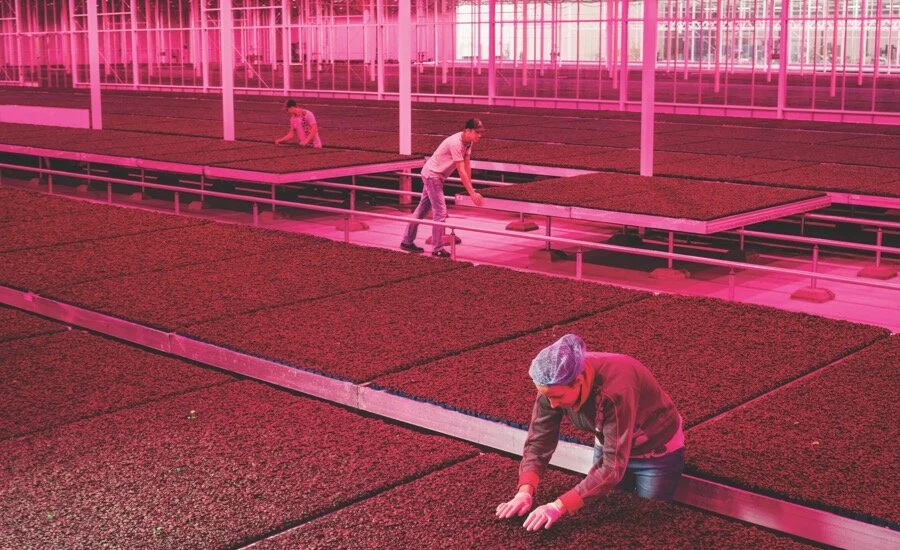
Highly artificial and sterile environments are employed to create the ideal organic specimen. Today’s glass houses contain all the essential ingredients of life but none of the redundancies: sun, soil, and water are emulated, optimized, and finally automated. Photo: Pieternel van Velden.