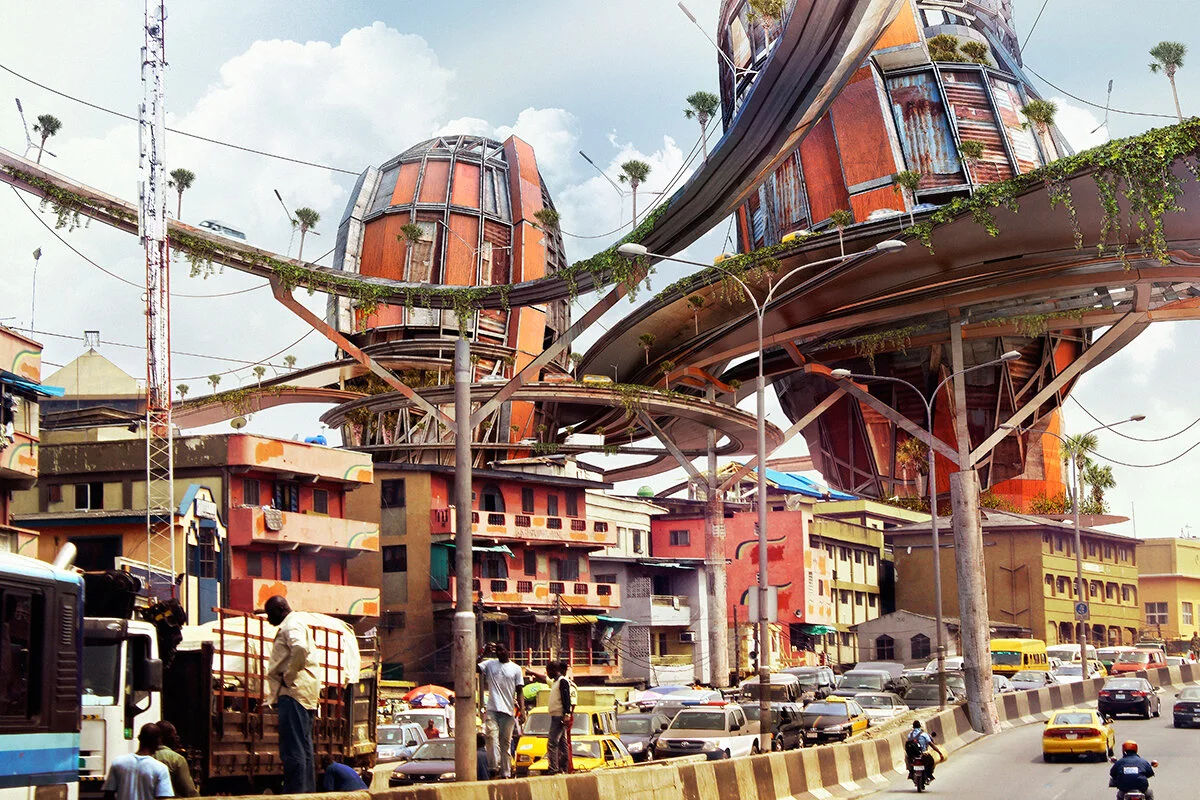
Shanty Mega-Structures, Olalekan Jeyifous, 2015
By Craig Wilkins. Originally published by University of Minnesota, 2006
“A revolution that does not produce a new space has not realized its full potential.” - Henri Lefebvre
I read somewhere that writing about music is like dancing about architecture. In this composition, I will illustrate the truth of those words—
although I trust, not in the way the author intended—as I identify and analyze the space produced by the hip hop revolution. I plan to argue that hip hop produces a (w)rapped space that is (1) a phenomenon of sonic organization and use, created in and by a distinct social context, (2) dependent on experience and memory, and linked to time in the form of the past, present, and future, (3) defined and communicated by people through patterns of use in the built environment. I will also address a specific spatial understanding of hip hop culture as it reverberates from rap music into the built environment, identifying four primary spatial principles evident in the physical manifestations of hip hop architecture—palimpsestic, anthropomorphic, performative, and adaptive—that are generated in response to spaces that represent the power of oppression. This hip hop spatial paradigm at once recalls, creates, and deploys new spaces that speak to the Africentric Diasporian project of identity embedded in rap music. Ready for a little sumpin’ sumpin’ special? I’m ’bout to break you off some (meaning: give you something to consider).
Social Formations of Sound
Music both creates and is created by a distinct social context essential to the development of identity and subjectivity. This reciprocal relationship anchors my view of sonic foundations of hip hop that is reinforced by several theoretical claims below and forms the basis of the music/space relationship.
Some Writings about Music . . .
Simon Frith and Angela McRobbie in their essay “Rock and Sexuality” position rock and pop music as the place where “boys and girls learn their repertoire of public sexual behavior.2 By drawing on theories that posit sexual subjectivity as a primary element of defining an individual’s or a group’s identity, and by focusing on music’s capacity to construct male and female identities among teenagers through socially sanctioned public sexual expression, they reject the notion of rock music liberating a long-repressed sexuality and instead posit that “the most important ideological work done by rock is the construction of sexuality.”3 They further argue that this construction is controlled by the “‘gatekeepers’ of the industry, who determine how people listen to [music].”4 This suggests that those who control the choices and forms of music that become available to listeners have an overdetermined influence on the construction of sexuality and identity of those listeners. George Lipsitz, in his book Time Passages, directly links the (sexual) identity produced by music to the notion of time by applying the concept of dialogical criticism developed by literary critic Mikhail Bakhtin. That concept is defined here as a dialogue with history—critically dependent upon memory—and with the study of music.5 It is his position that: “one reason for popular music’s powerful affect is its ability to conflate music and lived experience, to make both the past and present zones of choice serve distinct social and political interests.”6 In his analysis, Lipsitz posits that the socially defined public arena—that place where the everyday interactions of society takes place—“is the matrix of production and reception of popular music” and memory is central to the construction of that public arena.7 In his analysis, Lipsitz argues that not only is memory necessary for the construction of music, it is also central to the construction of social context and thus necessary for the construction of identity. Finally, in the essay, “The Sound of Music in the Era of its Electronic Reproducibility,” John Mowitt takes Lipsitz’s position a step further and argues that current technology has separated the production and reception of music, and it has “privileged the mo- ment of reception in cultural experience,” further illustrating the social context of music’s construction and its influence on subjectivity and identity.8 Key to this argument is Mowitt’s assertion that subjectivity is heavily influenced by the fact that experience “takes place within a cultural context organized by institutions and practices,” which in this case are the institution and practices of the music studio. He argues that the experience of hearing—and its concomitant effects on memory—is less influenced by initial production than by technical reproduction done in the studio and this curs as the effect produced by the operations that orient it, situate it, temporalize it, and make it function. . . . In short, space is a practiced place. Thus the street geometrically defined by urban planning is transformed into a space by walkers.”18
In sum, what is vital to understand from Lefebvre’s spatial theory is the notion that bodies (people) interacting produce space. This interaction is specific to a time, place, and social formation, but is also historical—it has a memory, a past. Space—like music—can- not be static; it is dynamic, adapted by its user for the communication of specific meanings as illustrated by de Certeau’s “pedestrian speech acts.” For Lefebvre and de Certeau, the formation of space is dependent on the interaction, the understanding of the interaction in a dialogically critical (reciprocal) way, and the memory of interaction (experience) communicated through the language of the pedestrian speech act. At its very essence, space, for them, is a “performed communication.” Lefebvre, de Certeau and others have allowed me to posit the notion of space as reciprocal and as:
1. a phenomenon of spatial organization and use, realized in a distinct social context (people interacting)
2. dependent on experience and memory, linked to time— past, present, and future
3. defined and communicated by people through patterns of use
Bet! (That means: definitely a sure thing.) Check that! (That means: read again.) This hypothesis is almost identical to the previously outlined notion of music and, as such, uncovers a heretofore hidden opportunity for further critical spatial inquiry. If space is derived from experience and memory, whose communication is performed, and music is derived from experience and memory, whose form of communication is performance, then might we not look at sound and space as a similar occurrence, constitutive of each other? If so, then space might be defined more specifically as a:
1. socially constructed phenomenon of sonic organization and use
2. dependent on experience and memory, linked to time— past, present, and future
3. defined and communicated by people through their patterns of use
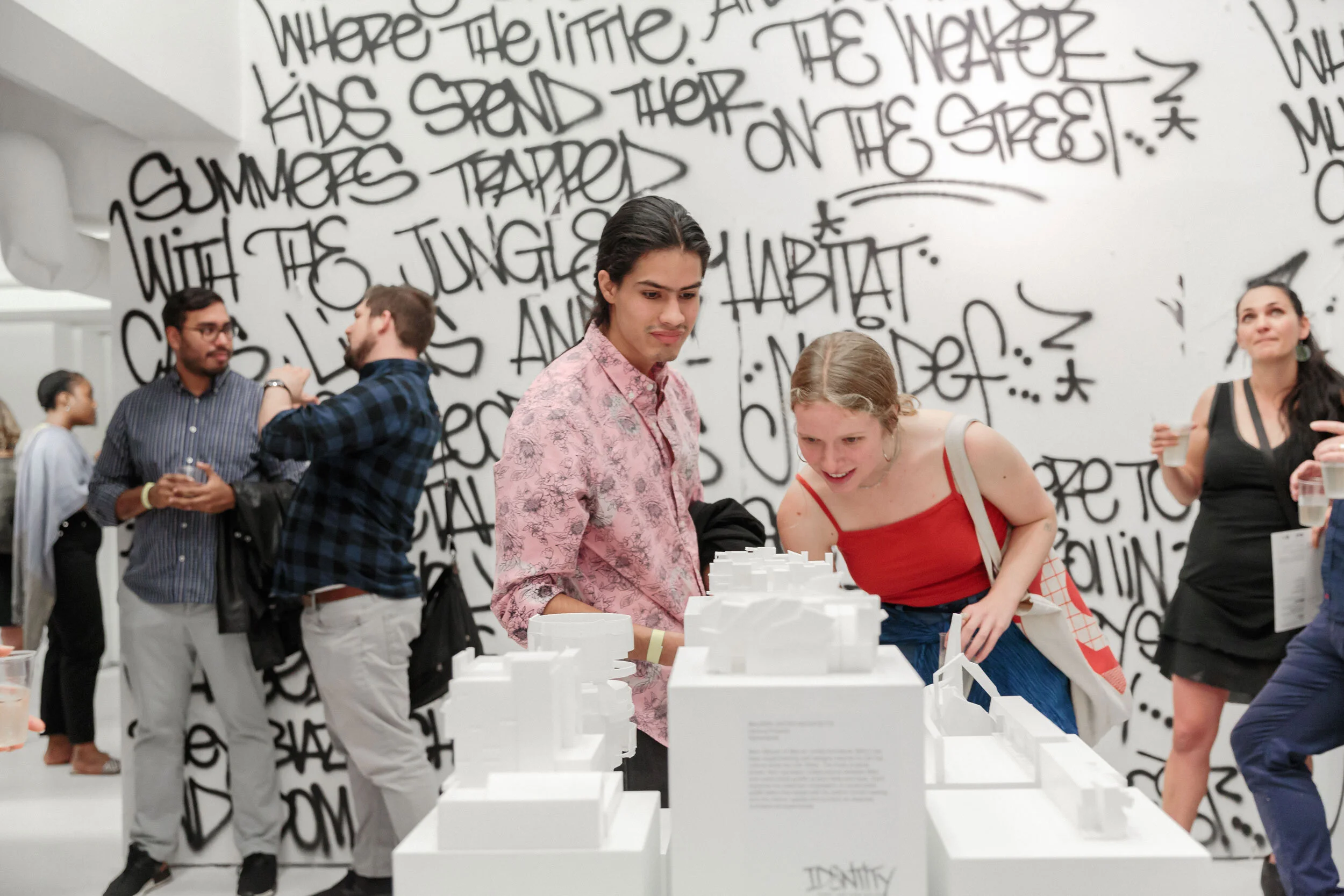
Close to the Edge: The Birth of Hip-Hop Architecture exhibit, 2018
Rap Formations of Space
More Writings about Music . . .
So, peep that. (Look closer / listen harder.). Sound-mediated or performed space becomes the key to understanding hip hop’s cultural creation—rap music—as the principal foundational element of Hip Hop Architecture.19 How, you say? Bust it! (Explanation to follow.)
Space is
1. socially constructed phenomenon of sonic organization and use . . . “[R]ap music is a technological form that relies on the reformation of the recorded sound in conjunction with rhymed lyrics to create its distinctive sound.” Rap music is unquestionably a music born of technology and is, as Mowitt has concluded previously, socially constructed. The core of rap music lies in the ability of the musical production (DJ, producer, engineer) to manipulate particular sounds, breaks, ruptures in continuity and flow—recalling their existence by their absence—and in the ability to mix several disparate sources of sonic pleasure into the listening experience. With the use of what is termed “sampling”—the digitally enhanced process of transferring a sound, or series of sounds (the sample), from one source to another source—“[r]ap technicians employ digital technology as instruments, revising black musical styles and priorities through the manipulation of technology.” The primacy of studio/ tech production has been key to the development of the rap genre and the epitome of a musical phenomenon created in a distinct so- cial context—the studio.
Space is
2. dependent on experience and memory, linked to time— past, present, and future . . . “Music is nothing but organized noise. You can take anything—street sounds, us talking, whatever you want—and make it music by organizing it.” As Mowitt has previously touched upon, music’s social importance is precisely this organization of noise around socially defined structures of listening. It is our shared understanding of the “correct” way to listen that is embedded in our memory and creates community. What becomes important to discern is: “Which community is forming in the musical technologies of the collective memory, and what is its relation to those technologies that facilitate the exact reproduction of the musician’s actions for listeners?”
Black music in general, but rap music’s historical connection with the collective memory of the African diasporic community in particular, is complex and varied, and the hierarchy of its components is not at all universally agreed upon. What is generally ac- knowledged as important, essential, and historical about Black music are: (a) its nature (rhythm, repetition, layering, flow, rupture), which recalls the link to its African origin; (b) its orality (toast, call and response, storytelling griot), which descends from specific African, Caribbean, and American influences; and (c) its content (oppression, segregation, self-determination, self-naming), which is constituted in part by the postmodern condition of fragmentation and the project of reclaiming the Black subject from the “Negro” object. These elements help to link the African diaspora over distance and time to a collective memory that is Afrocentric in origin and nature, but is— and this is key—specific to its current locale and defines a particular type of spatial practice, a principal tenet of Lefebvre’s social space.
Space is
3. defined and communicated by people through their patterns of use . . . The identity created by sound is best illustrated and understood by studying the use/influence of music on the lifestyles of the diaspora. As alluded to earlier in this essay by Albert Murray’s discussion of Romare Bearden, Black music is really an integral part of the way Blacks live and communicate. At its most basic level, music is for the diaspora an unconscious way of being that informs both the physical and mental response to its call and is acted out in all variety of ways, subtle and not. At its most heightened, it is a recognition and celebration of an Africentric life force. But at all levels, it is important, even essential, to the performance of life— Gilroy’s “enhanced mode of communication”—for diasporic mem- bers. This performance of life manifests itself in a variety of ways in the diaspora, but all are inexorably linked by the project of re- claiming the Black subject from the “Negro” object.
Rap music is clearly a tool to use in the process of redefining self. Whereas Dick Hebdige’s analysis of punk culture and music re- vealed as a central theme punk’s desire for an escape from the principle of identity, in hip hop culture and music, identity is paramount. Primary to rap music’s significance is that it produces, as Rose phrases it, a style that nobody can deal with, one that is “bigga and deffa.” With and within the music, producers express their individual and collective identity—the “who” we are—and, in a confluence of structuralist and Africentric discourses, the music calls upon the listener to express their identity—Are you “who” too? Thus an Africentric spatial practice, and a corresponding community, is at once recalled, produced, and enhanced in the music of the hip hop culture.
Rap Formation of Hip Hop
Architecture Some Dancing about Architecture . . .
So, “G” (partner in common or specific project), what does all this have to do with space, or for that matter, architecture? This next section will specifically address a spatial understanding of hip hop culture that employs this confluence of space and music as a paradigm that recalls, creates, and deploys new spaces that speak to the Africentric diasporian project of identity in the built environment. Hip hop architecture creates spaces that are constructed by the intersections of mobile elements—people (bodies)—but often includes objects of material culture (debris, monster speakers, cars) as well. Hip hop space is made readable by the ensemble and interaction of people and elements engaged in the performance of everyday life. These particular performances are a function of diasporian spatial practices that have survived the Middle Passage and are specifically recalled and enhanced by the music of rap. It is the rec- ognition of, and participation in, specific “pedestrian speech acts” or “performances of communication” that makes the space function and communicate. As such, hip hop architecture is a stage for Africentric identity emergence. The space of hip hop invites us to ask whether it is logical to expect a culture that has been placed on the margin of society’s concerns to employ the same language (pedestrian speech patterns or performances) used by those responsible for such marginalization, thereby reinforcing the very practice that is repressing them? Is it logical to expect the response of this com- munity to spaces that represent the power of their oppression to be the same as of those who developed such spaces? The answer that the paradigm of hip hop space provides to these two critical questions, so central to the validity of the discipline and profession of architecture, is a resounding, emphatic, and unequivocal no. Physical Manifestations of Hip Hop Space More Dancing about Architecture . . . Below I will outline four primary principles necessary for the physical manifestations of hip hop space. I am certainly not the first to recognize the power for spatial change that rap music provides. Houston Baker, Jr. states: “It would be salutary . . . if the ‘grim neighborhoods’ of public housing were to reap the benefits of the type of hearing provided by the Central Park moment. . . . [W]e might also find in our new public concern both exacting and effective ways to channel the transnational capital of everyday rap into a spirited refiguration of African-American urban territories.” I posit that strategies can be adapted from this transnational capital and manifested in built form. The accompanying images are part of a 1994 proposal to develop a Hip Hop Park on the near south side of Chicago. The site is a debris-laden vacant lot in the midst of one-to-three-story warehouses. The most prominent features of the actual site are the two partial facades that remain from the former building—a faux classical coliseum. The project demon-strates the application the following primary principles of (W)rapped space found below.
Hip Hop Architecture: Palimpsestic.
“The power and promise of rap music rests in the bosom of urban America. . . . [Y]ears of degradation, welfare handouts, institutional racism, and discrimination have created a community where little hope, low self-esteem, and frequent failure translates into drugs, teen pregnancy, and gang violence.”32 The architecture of hip hop is linked to the urban context in which it was born. This is where the call and response for the physical manifestation of this space is strongest. Part of the social context of the inner city—particularly in predominantly poorer AfricanAmerican communities—is one of disarray and decay. Everyday, intentionally unclaimed, naturally deconstructivist structures are allowed to fall away piece by piece in unattended lots that are typically appropriated by the local residents as places for sundry and nefari- ous activities. These are the available—and appropriate—sites for the construction of hip hop spaces. The charge here is to remake and reclaim the Black subject from the “Negro” object, and this calls for a remaking of these places, the erasure of the dominant “proper,” and the repositioning of these urban spaces as empowering. Thus, the first, and most basic principle of the physical manifestations of hip hop architecture is that it be palimpsestic in nature and intent. It is an erasure of both dominant spatial understandings of “proper” and its hegemonic physical manifestations, while simultaneously—in the same location—the construction of a hip hop spatial consciousness and its physical manifestations. Essential to this consciousness is the recognition that hip hop space flows, ruptures, and intersects with bodies. In hegemonic spatial structures, these things are viewed as discontinuations, accidents that were not planned (both in the architectural and the organizational sense). This spatial perspective is antithetical to the spatial organization inherent in hip hop. As a space formed by sound, such “ac- cidents” are designed and expected, and they are considered not only as continuous, but as invitations to perform. Hip hop architecture is palimpsestic in the fact that it is en- gaged in reclaiming the subject from the object. Consistent with the foundations of hip hop’s flow, layering, and rupture, the palimpsestic nature of hip hop architecture reorganizes and rewrites the “[v]isible boundaries [of architecture], such as walls or enclosures in general, [that] give rise for their part to an appearance of separation between spaces where in fact what exists is an ambigu- ous continuity” in the same location of the dominant culture’s hegemonic definition of “proper” spatial use.33 This reorganization’s primary objective is to recapture the Black subject from the “Negro” object and affirm the body’s identity in spaces that have historically done just the opposite.
Palimpsestic Application.
A specific application of the palimpsestic principle in the Hip Hop Park project is evidenced by the appropriation of space by the local youth as a place of recreation, due to the lack of available open space in their community in the manner of de Certeau. This park would authorize a place for the typical outdoor performances that occur regularly in this commu- nity, provide staging space for hip hop dancing, present wall space for graffiti artwork (tagging), and provide portable vendor booths along a “street and corner” within the park to serve as a hip hop community flea market. Providing for the specific spatial practices of this community assists in erasing the notion of this space as a place of vandalism and degradation, and it rewrites it—in the same place—as a place of validation and desire. The object was to approach the design of this space from a hip hop perspective that fo- cuses on the (re)affirmation of identity, incorporating principles of appropriation and adaptation to palimsestically create spaces specific to the needs of the user—the hip hop community.
Hip Hop Architecture: Anthropomorphic.
A principal purpose of hip hop architecture is to create a “home place” (as bell hooks has referred to it) or, for the purposes of this essay, a space that engages and employs similar identity (re)construction strategies that take place at various sites within the diaspora. Therefore, another primary principle of hip hop architecture, as it concerns reconstructing a positive Black identity, is that it be anthropomorphic, which is “in many respects, one of architecture’s universals . . . [and] is also a frequently expressed feature of architectural traditions in Africa.”34 The anthropomorphism in hip hop space is not concerned with typical Western understandings of the concept that focuses centrally on the physical attributes or appendages of the body. It is instead concerned with a holistic understanding of the place the body inhabits. It is similar to the DJ/producers’ call of “who we are” and as such, is intimately connected with the identity of the body within space. Unlike in the West, where “architectural anthropomorphism had its primary basis in the valuation of the human body as an expression of God’s creative perfection, African architects more characteristically see in the human a model of life and vitality and an expression of social relationships and values.”
Anthropomorphic Application.
As a space that is constructed by the bodies of its users, it is critical to consider the body in space and provide for its interaction in various forms and with various objects.
The park provides for the specific spatial practices of the hip hop community as these individuals define their space through pedestrian speech acts. Providing for cultural and communal use in this space in terms such as “pleasurable” and “desirable” is what brings the space of hip hop—and its subsequent architectural manifestation—into being. Thus the spaces provide not only for the tangible interaction in various forms of creating and viewing the performance of everyday life (the economic, political, communal, and physical exchanges) by people in motion, but also for the tactile interaction with (im)mobile objects (graffiti walls, speaker stands, vending booths) as well. The park is designed to facilitate this interaction, with the understanding that the more tangible and substantive the interaction, the more valuable and legitimate the architecture becomes.
Hip Hop Architecture: Performative.
To paraphrase Shakespeare, if “all the world’s a stage, and we are merely actors,” then the physical manifestation of a hip hop spatial understanding is this phrase’s most recent—and important—connotation. The notion of simultaneity—the intersection of body and stage around the construction of identity—communicated through performance is a primary element of the diaspora and must be a part of hip hop space.36 The organization of hip hop spatial understanding can be found in the deep call of the diaspora in rhythm and repetition. Hip hop architecture is the emergence—in form—of the base and the beat, the flow and the rupture, the call and response. Consequently, an additional primary principle of hip hop architecture is that it is performative. It is about both providing the stage (backdrop) and privileging (inviting) the performance, where space is produced through the conjunction of people within it. The importance of performance—both the everyday and the ceremonial—in the cre- ation of space in the diaspora, “underscores the centrality of architecture itself both as a setting for everyday life and ceremonial action and as a theater for the presentation of dramas for the community as a whole. Through these performances, key aspects of architectural meaning are given expression.”37
Performative Application.
The design of the Hip Hop Park can be viewed as one large stage, a stage for the performance of life for diasporic members—in this case, the hip hop community—that re- calls historical spatial practices that are specific to this particular location. Hip hop architecture is concerned primarily with identity, and central to the creation of that identity are patterns of performance that are created by the music, by the musicians, and by the listeners. Each of these activities is suggested (invited) in the design by their location, but they are not fossilized in these locations. Like the transformative nature of the hip hop culture, these spaces are easily changed (and most likely will be continuously transformed) by the users to meet the complex performance of spatial and identity construction. The spaces suggested for the performance by the musicians (the central stage) and by the listeners (passively in the center grass knolls and actively in the hip hop dance spots and the bazaar area) are designed to encourage their use as currently designed, but also to encourage their reorganization in other ways by the users, as the community continues to write and rewrite its identity in and on this space.
Hip Hop Architecture: Adaptive.
Finally, hip hop architecture is adaptive. It has to be. The sites that are available for the emergence of hip hop forms necessitate it; the people for whom the structures will be built will demand it; the availability of materials for this (these) project(s) requires it; the assemblage of these structures compels it. Hip hop architecture’s diasporic dialectic is inescapable. From its vegetal and mud and clay site-specific African origins, to the design of “shotgun homes” of the late eighteenth-century Caribbean and early nineteenth-century America, to the late nineteenth-century Tuskegee Institute/University project, to the thatched roofs of the early twentieth-century “critter houses” of South Carolina, hip hop architecture is also committed to using and reusing materials transformatively and creatively, removing the hegemonic “proper” not only from spatial communication but from symbol and material communication also. The architecture of hip hop embodies the spirit that architectural professor Laverne Wells-Bowie describes as “architecture as a cultural practice . . . [the] sense of architecture acknowledg[ing] diversity of location, that wherever folks are dwelling in space, they can think cre- atively about the transformation and reinvention of that space.”
Adaptive Application.
The current material culture available in the community has been adapted in the hip hop bazaar. Behind the con- cept of the bazaar is the desire to facilitate the entrepreneurial spirit of hip hop culture and to build on its “power from powerlessness” theme. This space is designed to facilitate young entrepreneurs, street vendors, and small community enterprises that would like to reach a larger and repeat clientele, but who do not have the initial capital investment for renting space for commercial needs, inventory, or storage. These enterprises provide a vital service—the underground economy that sustains many marginalized communities—but live a transient existence within the community.39 As such, the hip hop booths are a principal component of the bazaar/marketplace in this design and are designed to be easily assembled, disassembled, and transported. Made from wood, metal, wire, and canvas, they blend perfectly with the materials used in the park design, as the walls, flooring, and booths utilize the materials discarded in the neighborhood everyday—at once cleaning the ar- eas of debris and adapting the discarded into the useful. The can- vas covers of differing colors are intended to be utilized by neighborhood graffiti artists to simultaneously display their skills and to announce the various vendors in the bazaar, giving the mar- ket a particularly community flavor, creating an “‘architecture of the site’ as opposed to the architectural ideal of ‘an architecture on the site’” and adding yet another layer to the construction of individual and communal identity.
Conclusion
Writing about Music Is Like Dancing about Architecture . . .
In this essay, I have explored a particular relationship between rap music, space, and architecture. Rejecting previous investigative essays that focus on music, space, and architecture as being inadequately probative, I have employed a counterquest for an aesthetic paradigm of architectural and sonic production, one that approaches the question of music and architecture from the insideout. In this investigation I have positioned rap music as the womb from which hip hop space and architecture are born. Theory in architecture is all too often discussed only in terms of form. The ideology in architecture that permeates the profession and discipline is rarely analyzed. This piece attempts to open up that discussion on a number of levels. My primary purpose in en- gaging in this examination of music, space, and architecture is to begin to explore new paradigms of architectural spatial theory and manifestations that are initiated from the marginalized citizenry— specifically, the African-American community. This search is for a spatial paradigm that resists the power of dominant hegemonic understandings of space embedded and accepted in architecture and creates power for the marginalized from their built environment, primarily by identifying ways they can and do express their spatial practice in physical form to affirm their validity. The revolutionary production of hip hop space—a phenomenon of sonic organization and use created in a distinct social context, dependent on experience and memory, linked to time (past, present, and future), defined and communicated by people through their patterns of use in the built environment—has clearly been identified as a prototype demonstrative of an African-American spatial practice and available for physical expression. In this theorizing, the production of hip hop architecture is an attempt to “recover a sense of community outside the state-regulated and commodified universe” dependent on “a systematic reorganization of space to enlarge the realm of public discourse and physical freedom . . . a new code of space,” and it is an attempt to build upon the foundations of “expressive rather than instrumental (institutional) social relations.”41 Hip hop architecture takes as its point of departure a phenomonologist understanding of subjective/substitute images, and combines it with the notion of spatial construction through interrelations, into this “new code of space.” And here, you thought that it was only noise.
The preeminent principle in hip hop culture and its music is one of identity. Rap music employs various specific, identity (re)defining strategies developed by the African diaspora as a result of its Black “subject” from Negro “object” reclamation project. The specific spatial understanding of hip hop culture, embodied in the physical manifestations of hip hop architecture is predicated on the response to those spaces that represent an erasure of identity and, concomitantly, the presence of oppressive power. A hip hop spatial paradigm at once recalls, creates, and deploys a new space of diasporian origin and produces an architectural manifestation that is at once palimpsestic, anthropomorphic, performative, and adaptive. Hip hop architecture is engaged in taking existing architecture and transforming it into something that expresses the spatial practices of the residents of marginalized communities, an object that makes sense to them. By making architecture an artifact that is “owned” by reason of individual, community, and/or cultural rel- evance and reaffirms their identity as a people, the architecture of hip hop strives to make the built environment something desirable and therefore valuable to those inside and outside the community. Corbu recognized the necessity of transformation when he argued that “if we challenge the past, we shall learn that ‘styles’ no longer exist for us, that a style belonging to our own period has come about.”42 Snap! (Stop, something just clicked.) Check that. (Read again.) Corbu is (subconsciously?) stating that the discipline of ar- chitecture flows, with periodic breaks in its continuity. That it is, in effect, breakdancing. Architecture: hip hop(ing) through history. And all this time you thought you couldn’t dance.
We are in one of those moments in time where a “pop” or “rupture” in the performance is necessary. The old solutions (styles) no longer apply. Our concerns, our problems at this time, are different. Architecture should be about that, about responding to society now, with an eye always toward the future. When Bones, Thugs, and Harmony rap about “It’s The First of The Month” or Luniz raps that “I Got Five on It,” this speaks to the concerns of a broad spectrum of the populace and suggests modes of aesthetic solutions. Where are the structures that reflect these modes? Where is the building about which I can say: “I Got Five on It”? Inner-city design strategies to date primarily have been developed outside of the affected community. Strategies developed by “experts”—that look at the architecture of survival, of identity, of erasure and that determine that it is nothing more than vandalism—have emerged. But these strategies have emerged out of (a) a failure to understand what that architecture is really saying about the community that produced it and, (b) a willingness to impose narrowly defined spatial theories that masquerade as “universal” aesthetics upon an “other.” Historically, design in these marginalized communities from an universal (read: EuroAmerican) spatial understanding has not been “universally” successful. I live in a “Boogie-Woogie Bugle Boy” building, but I’d much rather live in a Boogie Down Productions space. Hip hop architecture calls on the architectural “flow” to develop a space “that nobody can deal with—a [space] that cannot be easily understood or erased, a [space] that has the reflexivity to create counterdominant narratives against a mobile and shifting enemy. . . . In the post-industrial ur- ban context of dwindling low-income housing, a trickle of meaningless jobs for young people, mounting police brutality, and increasingly draconian depiction’s of young inner-city residences, hip hop style is black urban renewal.”43
As such, hip hop architecture is one model for halting the destruction and deterioration of African-American urban commu- nities and the best hope to restore their viability as sustainable com- munities. The architectural entities that evolve from a hip hop spatial paradigm draw on the best of the past and the present. Employed in communities where there is a need and cry for an environment that does not repress but relieves, hip hop architecture replaces the constrictive with the supportive. It defines and assev- erates an African-American identity. Like rap music, hip hop architecture reuses and renames space and in the process “render[s] visible ‘black’ meanings, precisely because of, and not in spite of, its industrial forms of production, distribution, and consumption.”44 It nurtures a place where African-Americans can see a positive portrait of themselves in their environment.
To that end, I should mention that I am challenged in my thinking by the theoretical work of the Russian Constructivists in the early part of this century, whose essential task, as argued by one of its leading theorists Moisei Ginzburg, was the: “creation of ‘so- cial contenders’: buildings, complexes, or even whole cities that could not only perform their immediate functions but also motivate users (or, if necessary, constrain them) to new actions, new habits— and thereby new ways of living.”45
What the Constructivists identified above as “new ways of living,” is more accurately identified in my hypothesis as the specific African-American spatial practices of this cultural moment informed by transnational diaspora spatial practices. I am most intellectually stimulated by their notion of the “new urban design—the purposive production of urban meaning—[as being] productivist (and activist), mobile and demountable and diffuse in its forms and media” that enables structures where “all the accessories that a metropolitan street imposes on a building—illustrations, publicity, clock, loudspeaker, even the lifts inside—are drawn into the design as equally important parts and brought to unity” by “transform[ing] mediating signs, to add new signification to that already existing.”46
The Hip Hop Park project is an example of this type of effort, an effort to listen to what’s on the street and—literally—read the writing on the wall. As Gil-Scott Heron, anticipating Lefebvre while paving the way for this hip hop moment, has so eloquently said: “The revolution will not be televised. . . . It will be live.”