A new energy-saving technology that uses solar rays to cool buildings and the surfaces of objects
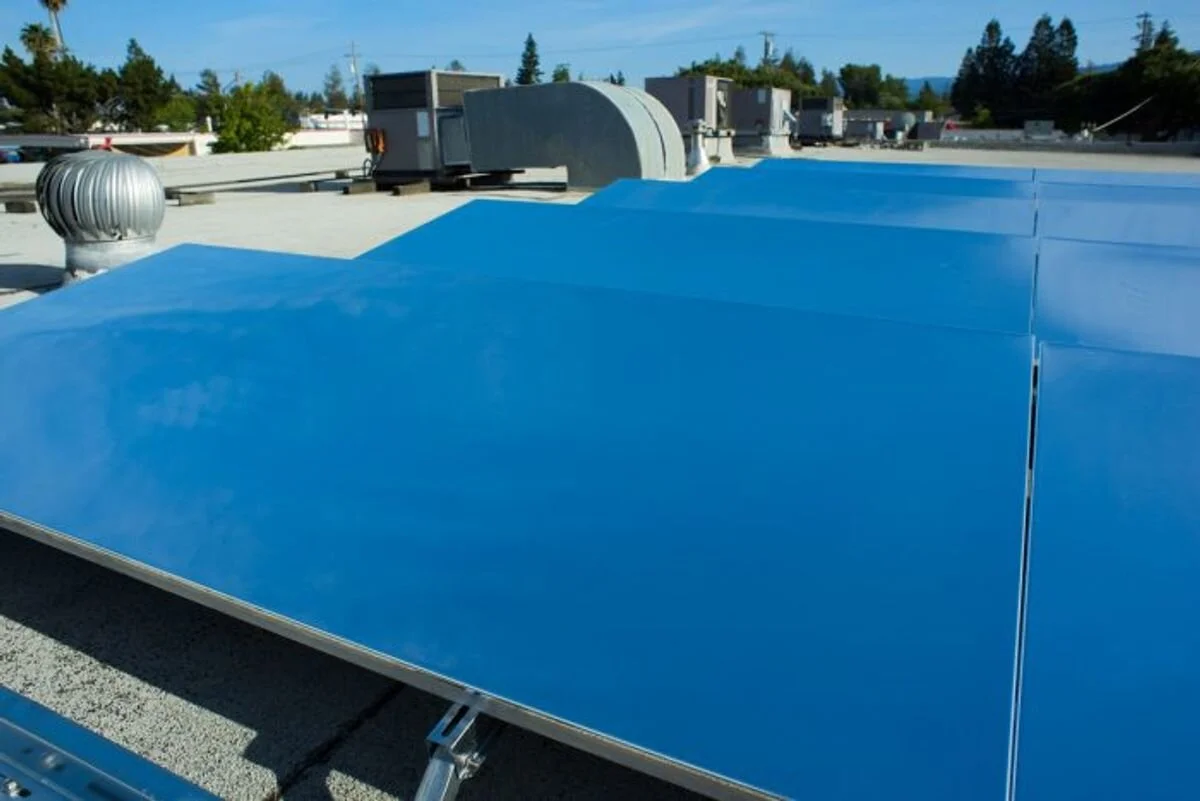
Compared to solar panels, SkyCool Systems claims its panels utilize roof-space more effectively, saving two to three times as much energy as a comparable solar array. Since the SkyCool panels do not need to be south-facing, they can complement solar panels on the roof—image from SkyCool Systems.
We associate radiative energy with heat, as in the case of as sun rays warming a winter greenhouse. Now imagine sunlight used for cooling. Contrary to our everyday experience, researchers at SkyCool Systems have patented the technology to turn bright, broad daylight into a renewable source for air conditioning. According to the company, their cooling panels reflect heat toward the sky and beyond the atmosphere. The system works only during the day and performs best in hot, sunny climates, such as Southern California. Unlike heat pumps, air-conditioning units, or standard solar arrays that contribute to the heat-island effect, the SkyCool units don’t dump heated air back into the environment.
The SkyCool panels emit thermal radiation through our atmosphere to the cold of outer space. The company claims their units will save three times the energy produced by a similar array of photovoltaics. The technology involves a thin, multilayer film developed by Aaswath Raman, an engineering professor at the University of California Los Angeles. The film reflects both visible light and infrared wavelengths transparent to the blanketing effect of the atmosphere.
In an article in National Geographic, Raman compares the atmosphere to a blanket with holes in it. By developing materials that emit infrared radiation at the specific wavelengths that escape through those “holes” in the atmosphere, Rama achieved the elusive goal of creating a substance that cools itself, well below ambient temperatures, without using electricity. In other words, passive-solar cooling.
Practical applications
Today, Raman is involved in a project called Heat Resilient Los Angeles that aims to install passive cooling systems throughout the city to demonstrate a solution to the urban-heat-island effect that may prove more efficient than planting shade trees.
As a commercial venture, the company founded on Raman’s research envisions bringing electricity-free cooling to the world. SkyCool Systems has deployed panels that cool refrigerant lines in rooftop installations to reduce energy costs for high consumers, such as grocery stores and data centers. Panels work like solar water heaters, only in reverse, cooling air-conditioning liquids to lower energy demands. The energy savings at one energy-sucking data center amounted to 70%. At a Circle K convenience store in Sacramento, Calif., SkyCool Systems installed 15 rooftop panels connected to the store’s walk-in freezer and an ice machine, resulting in a 15% reduction in daily energy use for the freezer and a 25% reduction for the ice machine.
Beyond air conditioning, engineers could apply thin-film technology to all manner of objects to provide passive cooling. For example, it could be added to automotive paint to reduce the need for air conditioning during summer commutes. One scientist profiled in the National Geographic article envisions large-scale arrays coated with Raman’s films to reverse global warming. For now, the technology remains experimental, with questions looming about the film’s durability, especially on rooftops.
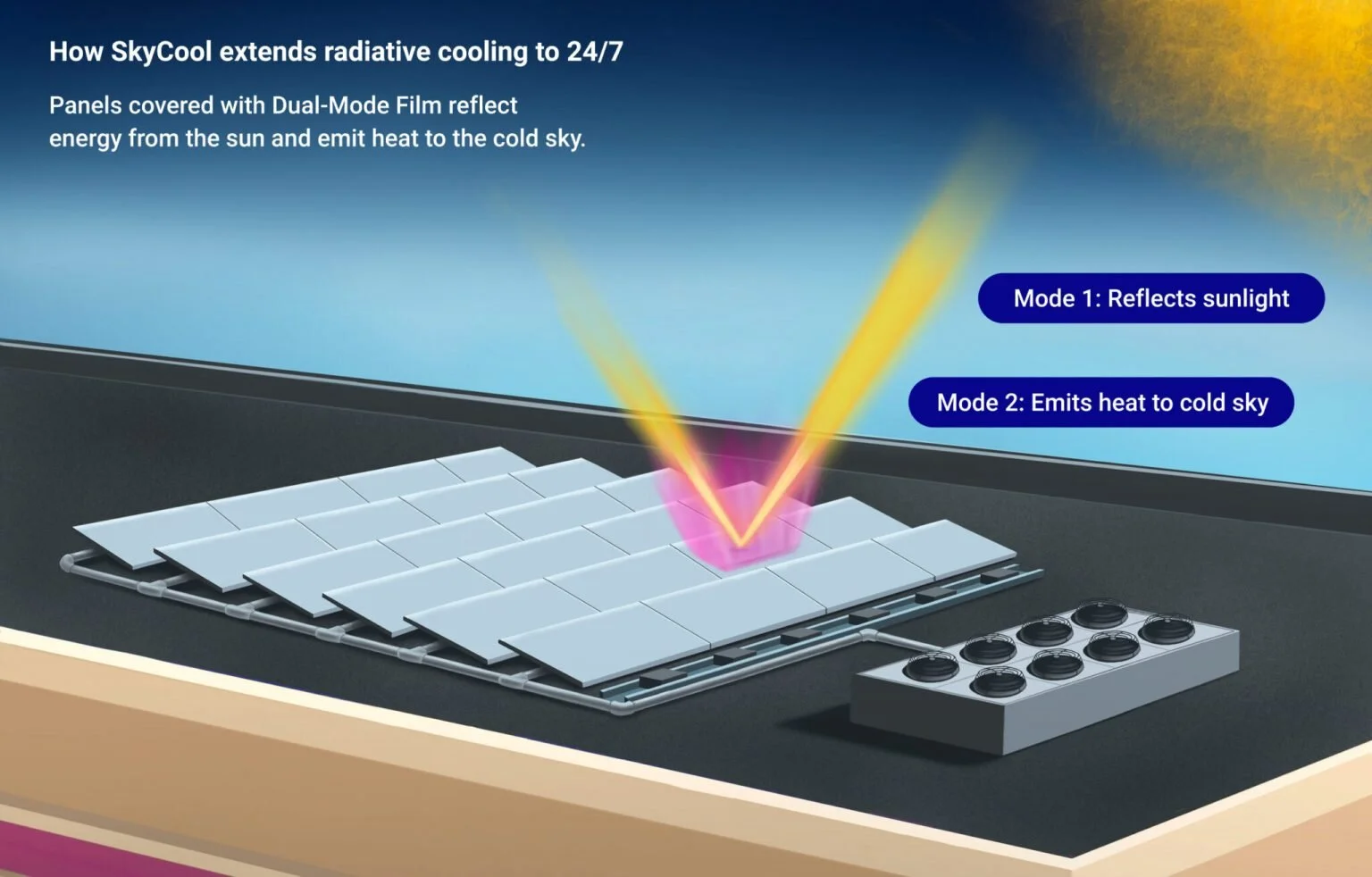
SkyCool panels passively cool fluids in air-conditioning and refrigeration systems. It’s counterintuitive, but the thin, solar-cooling coatings on the panels send heat right through the upper atmosphere to the cold of outer space. It works the same way radiative cooling occurs at night when surface temperatures drop in the absence of the sun. However, the cooling effect occurs in broad daylight.
Assuming the systems prove themselves over time, imagine roof shingles and house paints developed to keep our homes comfortable without a single kilowatt of energy. These special surfaces would remain cold to the touch even under the blazing sun. In the future, Raman envisions a complete air-conditioning system that uses no electricity. While films would also keep solar cells cool, preserving their energy-generating efficiency. With the new, passive radiative-cooling materials, the sky’s the limit on how we may stay cool in our warming world.