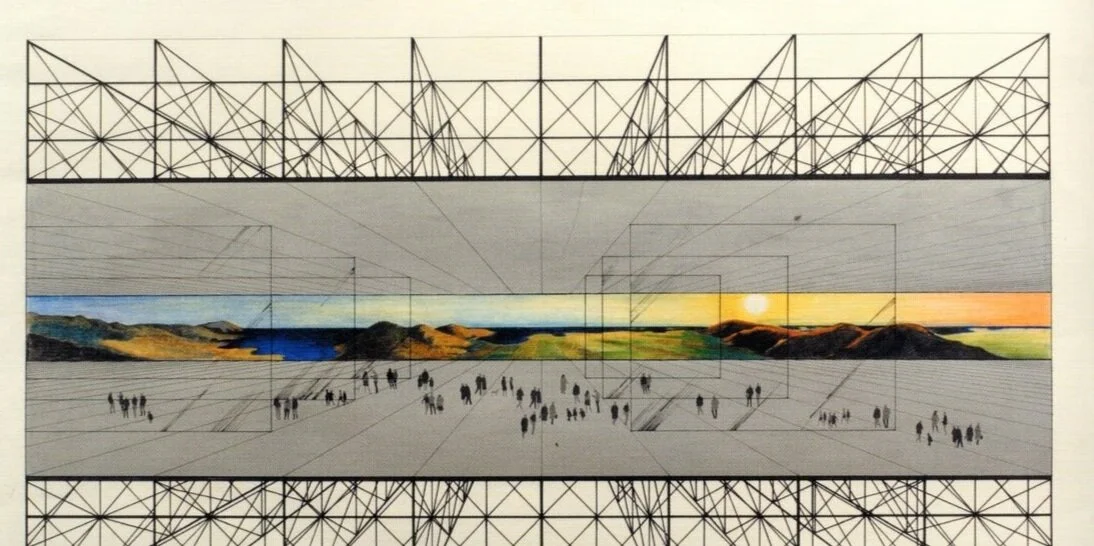
‘No-Stop City. Veduta di città’, c1970 by the radical Italian architects Archizoom. One of the members, Andrea Branzi, described ‘a society freed from its own alienation, emancipated from the rhetorical forms of humanitarian socialism and rhetorical progressivism’.
By Reinier De Graaf. Originally published by The Architectural Review in April, 2015, and later in de Graff’s book, Four Walls and a Roof, published in 2017.
As large housing estates are being demolished and the age of great social democracies recedes, taking with it any notion of an architecture for the public, OMA partner Reinier de Graaf asks if there is any alternative to building capital
It is almost a year since Thomas Piketty published his book, Capital in the Twenty-First Century. If Piketty is right, we can once and for all bury the illusion that the present economic system ultimately works in the interest of all and that its benefits will eventually trickle down to the poorest in society. Contrary to what every economist after Keynes has been telling us, the inequality produced by capitalism may not be a temporary phase that will ultimately be overcome; it is rather a structural and inescapable long-term effect of the system itself. Piketty’s analysis is exceedingly simple. He identifies two basic economic categories: income and wealth. He then proceeds to define social (in)equality as a function of the relation between the two over time, concluding that as soon as the return on wealth exceeds the return on labour, social inequality inevitably increases. Those who acquire wealth through work fall ever further behind those who accumulate wealth simply by owning it. Only during the 20th century - under the pressure of two world wars, social unrest, revolutions, labour unions and the daunting presence of a global alternative to the capitalist system in the form of a (former) communist world - only during this unique capsule of time, was capital briefly surpassed by labour as the prime means to accumulate wealth.
Whether or not the 20th century was a brief exception in the inescapable mechanism of a deeply fraught economic system remains to be seen. Much will depend on what happens next: the 21st century will determine the legacy of the 20th. So far, the signs are not encouraging: since the late 1970s, after the great conservative revolution set in motion by Reagan and Thatcher, the promise of accumulating wealth through work has steadily lost ground. The fall of the Berlin Wall (generally claimed as a victory of that same conservative revolution) and in its wake, the wholesale collapse of the Communist Bloc, have exacerbated this trend. If current indicators are right, we could well be faced with a situation in the near future where, for the first time since the end of the 19th century, returns on wealth through ownership will again exceed those of labour.
Indeed, if Piketty’s argument holds true, the 20th century will have been no more than an anomaly: a brief interruption in the systemic logic of capitalism, where the inherent accretion of capital through capital remains an unbreakable cycle. This simple economic conclusion may have social and cultural implications beyond our wildest imagination. When a lifetime of labour can no longer match the returns on an acquired fortune, inherited wealth once again becomes the defining factor of class distinction, reducing any notion of social mobility to a remote possibility at best.
Furthermore, if the 20th century really was an anomaly, then perhaps so were its ideals: an entire period characterised by an enlightened belief in progress, social emancipation and civil rights can be retroactively discarded as a fleeting moment of self-delusion - (no more than) a footnote in the long course of history. For the generation currently in a position of power, raised and educated in the 20th century, this is difficult to acknowledge. For them, the moral imperatives of the 20th century are beyond question, irrespective of political choices. (Even the most ardent supporter of the current free market economy probably does so only because s/he believes that the system ultimately acts in the interest of all, rather than explicitly supporting the notion of inequality.) The current generation, whether left or right, has not (yet) had its faith in the great emancipatory mechanisms shaken in any way. It is all they know and all they have ever known.
I was born in 1964, started primary school in 1970 and graduated from university in 1988, one year before the fall of the Berlin Wall. I received 18 years of public education, during which the notion/dogma that one progressed through study and hard work was firmly instilled. You earned your rights and did not inherit privileges. Education was received on the proportional basis of your talents, not the size of your wealth. We lived in the conviction that cultural and religious differences, Protestant and Catholic alike - there was no sizeable Muslim population yet - would eventually merge into a single middle class. The absence of a poor ‘under class’ was generally interpreted as the logical consequence of the (apparent) absence of an ‘upper class’. Inasmuch as we were aware of an upper class, in no way did we have to reckon with or even acknowledge them. Sure, we had a monarchy, but even their implication in the occasional corruption scandal in no way shocked our faith in their absolute irrelevance. They were a symbolic necessity, there to represent the unity of a nation that in every other respect was getting by without them. Power was in the hands of an elected government, independent of our royal head of state. (It was not until much later, until the mysterious release of Dutch Greenpeace activists in Russia, that I realised things were perhaps not that straightforward …) Wealth existed, but it did not guarantee a right to power, nor should it. Our leaders were chosen by us, for us, from us.
If Piketty is right, those self-evident ‘truths’ may well have been based on quicksand. The many privileges/blessings of a life in the latter 20th century, particularly in Western Europe, were not the natural outcome of a progressive evolutionary process, but the result of a short-lived and unsustainable suspension of the real fate dictated by its contemporary economic system. Only under severe (political) pressure did capital refrain from showing its true face. In that context, Western Europe got a good deal - protected by American intolerance towards the threat of Communism, but itself threatened (or savvy) enough to maintain a generous welfare system, dissuading its citizens from entertaining any real Communist sympathies of their own. With the dissolution of the Communist Bloc, much of that threat is gone and the economic trends of most European countries after 1989 speak subsequent volumes: welfare cuts, the erosion of pensions, the reduction of public services, and so on.
Although my training as an architect might make me utterly unqualified to comment on Piketty’s economic theories, I certainly cannot help but notice the resonance between Piketty’s narrative of ‘economic history’ and the context of my own profession. If you study the history of architecture, and particularly that of the last century, a striking confluence emerges between what Piketty identifies as the period of the great social mobility and the emergence of the Modern Movement in architecture, with its utopian visions for the city. From Le Corbusier to Ludwig Hilberseimer, from the Smithsons to Jaap Bakema: after reading Piketty, it becomes difficult to view the ideologies of Modern architecture as anything other than (the dream of) social mobility captured in concrete.
Let’s take a closer look. Until 1914, the returns on capital enjoy a comfortable lead over economic growth; from 1914 to 1950, the period of the great wars, that relationship reverses.2 Not only does this period signify a turning point economically, it also marks a major cultural shift as the period during which the great Modernist visions emerge. Shortly before the outbreak of the First World War, ‘The Futurist Manifesto’3 was published in Le Figaro. The spirit in which it is written is one of a deliberately reckless and unconditional embrace of the new. The manifesto glorifies speed, machinery and violence as the dawning of a new era. In announcing great crowds excited by work, pleasure and turmoil4 it ‘describes’ the Russian revolution before it happens. The Futurists insist that ‘Man will not be overtaken by progress, but instead Man will absorb progress in its evolution … reacting against the potentially overwhelming strength of progress, and shouting out his centrality.’5 This ‘triumph of the will’, more than the aggressive nationalism it is generally associated with, is a definitive reckoning with the laissez-faire of 19th-century Italy and the lethargy of its ruling class, to be abolished in favour of cultural rejuvenation and an aggressive modernisation.
A belief in the promises of modernisation continues to dominate much of the rest of the century. It results in a curious alternation between brutal industrial wars and utopian blueprints, the latter of which hope to deploy the (ensuant) maelstrom of industrial development for the greater good. In this respect there is a clear resonance with Piketty’s book, which observes a close relation between the progress made during the 20th century and the upheavals that went with it, noting that somehow no manifestation of the new ever unfolds without unsettling the old vested interests and established relations of power. The great visionary actors in architecture - from the Futurists to the Constructivists, from CIAM to Team X, from the Metabolists to Archizoom - invariably seemed to have coupled their embrace of the new to a need to settle scores with (read: destroy) the old. Despite its mostly social(ist) mission, there is an element of unabashed cruelty in the depiction of the ‘city of tomorrow’, with its repetitive, industrially produced housing blocks and ambitiously over-dimensioned infrastructural systems. Good intentions are dressed up in harsh vestments, as if to convey the brutal truth that progress comes at a price.
As large housing estates are being demolished and the age of great social democracies recedes, taking with it any notion of an architecture for the public, OMA partner Reinier de Graaf asks if there is any alternative to building capitalIt is almost a year since Thomas Piketty published his book, Capital in the Twenty-First Century.1 If Piketty is right, we can once and for all bury the illusion that the present economic system ultimately works in the interest of all and that its benefits will eventually trickle down to the poorest in society. Contrary to what every economist after Keynes has been telling us, the inequality produced by capitalism may not be a temporary phase that will ultimately be overcome; it is rather a structural and inescapable long-term effect of the system itself. Piketty’s analysis is exceedingly simple. He identifies two basic economic categories: income and wealth. He then proceeds to define social (in)equality as a function of the relation between the two over time, concluding that as soon as the return on wealth exceeds the return on labour, social inequality inevitably increases. Those who acquire wealth through work fall ever further behind those who accumulate wealth simply by owning it. Only during the 20th century - under the pressure of two world wars, social unrest, revolutions, labour unions and the daunting presence of a global alternative to the capitalist system in the form of a (former) communist world - only during this unique capsule of time, was capital briefly surpassed by labour as the prime means to accumulate wealth.
Whether or not the 20th century was a brief exception in the inescapable mechanism of a deeply fraught economic system remains to be seen. Much will depend on what happens next: the 21st century will determine the legacy of the 20th. So far, the signs are not encouraging: since the late 1970s, after the great conservative revolution set in motion by Reagan and Thatcher, the promise of accumulating wealth through work has steadily lost ground. The fall of the Berlin Wall (generally claimed as a victory of that same conservative revolution) and in its wake, the wholesale collapse of the Communist Bloc, have exacerbated this trend. If current indicators are right, we could well be faced with a situation in the near future where, for the first time since the end of the 19th century, returns on wealth through ownership will again exceed those of labour.
Indeed, if Piketty’s argument holds true, the 20th century will have been no more than an anomaly: a brief interruption in the systemic logic of capitalism, where the inherent accretion of capital through capital remains an unbreakable cycle. This simple economic conclusion may have social and cultural implications beyond our wildest imagination. When a lifetime of labour can no longer match the returns on an acquired fortune, inherited wealth once again becomes the defining factor of class distinction, reducing any notion of social mobility to a remote possibility at best.‘No-Stop City. Veduta di città’, c1970 by the radical Italian architects Archizoom. One of the members, Andrea Branzi, described ‘a society freed from its own alienation, emancipated from the rhetorical forms of humanitarian socialism and rhetorical progressivism’Furthermore, if the 20th century really was an anomaly, then perhaps so were its ideals: an entire period characterised by an enlightened belief in progress, social emancipation and civil rights can be retroactively discarded as a fleeting moment of self-delusion - (no more than) a footnote in the long course of history. For the generation currently in a position of power, raised and educated in the 20th century, this is difficult to acknowledge. For them, the moral imperatives of the 20th century are beyond question, irrespective of political choices. (Even the most ardent supporter of the current free market economy probably does so only because s/he believes that the system ultimately acts in the interest of all, rather than explicitly supporting the notion of inequality.) The current generation, whether left or right, has not (yet) had its faith in the great emancipatory mechanisms shaken in any way. It is all they know and all they have ever known.
I was born in 1964, started primary school in 1970 and graduated from university in 1988, one year before the fall of the Berlin Wall. I received 18 years of public education, during which the notion/dogma that one progressed through study and hard work was firmly instilled. You earned your rights and did not inherit privileges. Education was received on the proportional basis of your talents, not the size of your wealth. We lived in the conviction that cultural and religious differences, Protestant and Catholic alike - there was no sizeable Muslim population yet - would eventually merge into a single middle class. The absence of a poor ‘under class’ was generally interpreted as the logical consequence of the (apparent) absence of an ‘upper class’. Inasmuch as we were aware of an upper class, in no way did we have to reckon with or even acknowledge them. Sure, we had a monarchy, but even their implication in the occasional corruption scandal in no way shocked our faith in their absolute irrelevance. They were a symbolic necessity, there to represent the unity of a nation that in every other respect was getting by without them. Power was in the hands of an elected government, independent of our royal head of state. (It was not until much later, until the mysterious release of Dutch Greenpeace activists in Russia, that I realised things were perhaps not that straightforward …) Wealth existed, but it did not guarantee a right to power, nor should it. Our leaders were chosen by us, for us, from us.
If Piketty is right, those self-evident ‘truths’ may well have been based on quicksand. The many privileges/blessings of a life in the latter 20th century, particularly in Western Europe, were not the natural outcome of a progressive evolutionary process, but the result of a short-lived and unsustainable suspension of the real fate dictated by its contemporary economic system. Only under severe (political) pressure did capital refrain from showing its true face. In that context, Western Europe got a good deal - protected by American intolerance towards the threat of Communism, but itself threatened (or savvy) enough to maintain a generous welfare system, dissuading its citizens from entertaining any real Communist sympathies of their own. With the dissolution of the Communist Bloc, much of that threat is gone and the economic trends of most European countries after 1989 speak subsequent volumes: welfare cuts, the erosion of pensions, the reduction of public services, and so on.‘If the 20th century really was an anomaly, then perhaps so were its ideals: an entire period characterised by an enlightened belief in progress, social emancipation and civil rights can be retroactively discarded’Although my training as an architect might make me utterly unqualified to comment on Piketty’s economic theories, I certainly cannot help but notice the resonance between Piketty’s narrative of ‘economic history’ and the context of my own profession. If you study the history of architecture, and particularly that of the last century, a striking confluence emerges between what Piketty identifies as the period of the great social mobility and the emergence of the Modern Movement in architecture, with its utopian visions for the city. From Le Corbusier to Ludwig Hilberseimer, from the Smithsons to Jaap Bakema: after reading Piketty, it becomes difficult to view the ideologies of Modern architecture as anything other than (the dream of) social mobility captured in concrete.Glasgow’s Red Road flats by Sam Bunton&Associates, built in the mid 1960s, were billed for demolition at the 2014 Commonwealth Games opening ceremony, but this tasteless plan was scrapped by dint of public outrage. Of the original eight blocks, two were demolished, in 2012 and 2013, and the remaining structures face an uncertain futureLet’s take a closer look. Until 1914, the returns on capital enjoy a comfortable lead over economic growth; from 1914 to 1950, the period of the great wars, that relationship reverses.2 Not only does this period signify a turning point economically, it also marks a major cultural shift as the period during which the great Modernist visions emerge. Shortly before the outbreak of the First World War, ‘The Futurist Manifesto’3 was published in Le Figaro. The spirit in which it is written is one of a deliberately reckless and unconditional embrace of the new. The manifesto glorifies speed, machinery and violence as the dawning of a new era. In announcing great crowds excited by work, pleasure and turmoil4 it ‘describes’ the Russian revolution before it happens. The Futurists insist that ‘Man will not be overtaken by progress, but instead Man will absorb progress in its evolution … reacting against the potentially overwhelming strength of progress, and shouting out his centrality.’5 This ‘triumph of the will’, more than the aggressive nationalism it is generally associated with, is a definitive reckoning with the laissez-faire of 19th-century Italy and the lethargy of its ruling class, to be abolished in favour of cultural rejuvenation and an aggressive modernisation.
A belief in the promises of modernisation continues to dominate much of the rest of the century. It results in a curious alternation between brutal industrial wars and utopian blueprints, the latter of which hope to deploy the (ensuant) maelstrom of industrial development for the greater good. In this respect there is a clear resonance with Piketty’s book, which observes a close relation between the progress made during the 20th century and the upheavals that went with it, noting that somehow no manifestation of the new ever unfolds without unsettling the old vested interests and established relations of power. The great visionary actors in architecture - from the Futurists to the Constructivists, from CIAM to Team X, from the Metabolists to Archizoom - invariably seemed to have coupled their embrace of the new to a need to settle scores with (read: destroy) the old. Despite its mostly social(ist) mission, there is an element of unabashed cruelty in the depiction of the ‘city of tomorrow’, with its repetitive, industrially produced housing blocks and ambitiously over-dimensioned infrastructural systems. Good intentions are dressed up in harsh vestments, as if to convey the brutal truth that progress comes at a price.The Druzhba (friendship) sanatorium, Yalta, Ukraine – designed by Russian architect Igor Vasilevsky with Nodar Kancheli and completed in 1986 – was envisaged as a social condenserPiketty has been viewed as a Marxist. This is wrong. Where Marx saw social relationships and class struggles, Piketty sees only economic categories: wealth and income. Marx envisaged proletariat rule through revolution, Piketty’s views are rather apolitical. Indeed, if Piketty’s analysis is at all political, it is only because he recognises the relevance of political choices in the context of signalling capital’s natural tendency towards inequality, which is best countered when the opposition between political sides is prolonged without end. In this view, the emancipating achievements of the 20th century owe their existence largely to a contest between opposing political camps and would last only as long as victory for any one party is suspended.
Thus does the concept of struggle itself move to the centre, not struggle between social classes, but as form of necessary agonistic pressure on the system … perhaps even an indispensable part of the system itself, one that can never relent if the system is to remain progressive. ‘Except in struggle, there is no more beauty’, wrote the Futurist Marinetti, followed by: ‘No masterpiece without an aggressive character.’6 Also here an interesting echo with the Modern Movement emerges. Modern architecture is invariably considered to be political, but by and large its political life has proved promiscuous. Italian Fascism was a sponsor of Modern architecture, as was Communism until Stalin. Le Corbusier served both the USSR and the Vichy regime. It is mostly in a desire to overthrow the old that commonalities between these systems can be found: a shared belief that whatever the consequences of action are, the consequences of inaction would be greater. In hindsight then, the social mobility of the 20th century becomes not a victory of the left over the right, but of new over old: a cleansing of the existing social order in the name of levelling the playing field. Maybe that is the main idea encapsulated, albeit strangely, in Le Corbusier’s statement: ‘Architecture ou Révolution’,7 wherein architecture is presented as a way to prevent (violent) revolution, embodying an (ideological) revolution in itself. Despite all the hallmarks of leftist rhetoric, somehow this slogan proposing that architecture replaces politics, remains apolitical. Political oppositions dissolve in a battle between new and old - in a choice between progress and regress.
The resonance of Piketty’s historic analysis of capital with the progression of architectural history is eerie at times. The first intersection (economic output exceeding the returns on capital) just prior to the First World War clearly coincides with the emergence of the avant-garde, but the resonance even applies at a more subtle level within the 20th century itself. From the early- to mid-1970s, for the first time in the 20th century, the lead of economic output over the returns on capital begins to diminish. And towards the end of the 1970s, a different political wind begins to blow. The conservative revolution first sweeps America and later Europe, forcing an agenda of economic liberalisation and the slashing of government spending. The size of the public sector is steadily reduced and large public housing projects become a thing of the past. This period essentially and concurrently marks the end of an unfettered belief in the merits of modern architecture. In 1972, the Pruitt-Igoe public housing estate in St Louis is demolished, an event that is generally heralded by critics as the ‘end’ of modern architecture - and on a larger scale, the end of modern utopian visions for the city. After the demolition of Pruitt-Igoe, the confidence in the architectural profession is severely shaken. The mood becomes pensive, the major seminal works of architecture are no longer plans but books, no longer visions but reflections. It is telling that the most noteworthy architectural manifesto of 1989, the year of the fall of the Berlin Wall and the onset of an uncontested global rule of capitalism, is A Vision of Britain by Prince Charles. The modern age prefigured in ‘The Futurist Manifesto’, at the tail end of the Ottocento with its hereditary hegemonies, ironically concludes with an anti-modern manifesto written by a member of the British Royal Family.
If the egalitarian climate of the ’60s and ’70s had made modern architecture generally unpopular, the neoliberal policies of the ’80s and ’90s made it obsolete. The initiative to construct the city comes to reside increasingly with the private sector. ‘Thought production’ by the architectural profession, in the form of theoretical manifestos or wholesale urban visions, gradually comes to a standstill. The very grain through which the city is constructed changes. Large interventions in the city, using public housing projects as the texture from which to compose a new, alternative urban fabric, become virtually impossible.
As part of a wholesale privatisation programme, public housing associations are privatised and home ownership takes a dramatic rise. By transforming large sections of society from tenants into home owners, the prevailing powers also hope to garner political sway. As soon as people own their homes, a mortgage will give them a vested interest in keeping interest rates and inflation down. Locked into an inescapable financial reality, they will have little alternative but to sympathise with the economic agenda of the right. Home owners, it is reasoned, will form an instantaneous conservative constituency.
Yet, over the decades to come, the new allegiance between the middle class and the right turns out to be a marriage of inconvenience. The conservative revolution had relied on two pillars: a permanent rise of property values (to maintain the desire for home-ownership) and wage moderation (to maintain the economy’s competitive power). It would only be a matter of time before the combination of these two would clash, exposing the whole system which allowed people to ‘buy in’ as something of a Faustian pact. With property appreciating value quicker than incomes rise, homes became ever more unaffordable; each generation of buyers suffering from that same condition by which the first owners had gained profit.‘Once discovered as a form of capital, there is no choice for buildings but to operate according to the logic of capital. In that sense there may ultimately be no such thing as Modern or Postmodern architecture, but simply architecture before and after its annexation by capital’Piketty’s observation on the returns of wealth over income manifest clearly in real-estate narratives of the last decades. Real estate is a prime example of how capital, after a first wave of seemingly working to people’s advantage, inevitably acquires a dynamic of its own. With time, the basic possibility to own one’s home is progressively beyond the reach of more and more people.
After the conservative revolution, the built environment and particularly housing acquired a fundamentally new role. From a means to provide shelter, it becomes a means to generate financial returns. A building is no longer something to use, but to own (with the hope of increased asset-value, rather than use-value, over time). Through the general deployment of the term ‘real estate’, the definition of the architect is replaced by that of the economist. This is also the moment that architecture becomes definitively inexplicable (at least in line with the criteria according to which architects usually explain architecture). The logic of a building no longer primarily reflects its intended use but instead serves mostly to promote a ‘generic’ desirability in economic terms. Judgement of architecture is deferred to the market. The ‘architectural style’ of buildings no longer conveys an ideological choice but a commercial one: architecture is worth whatever others are willing to pay for it.
This is also the moment that architecture and marketing become indistinguishable. A curious reversal of process follows: computer renderings precede technical drawings, the sale of apartments precedes the design of structure, the image precedes the substance, and the salesman precedes the architect. Perhaps Aldo van Eyck’s famous tirades against
Postmodernism in the 1980s were actually nothing more than the expression of desperation or indignation, that somehow our work had been hijacked.