It’s a bright, chilly winter morning in Cambridge, Massachusetts, and in Peet’s cafe, just around the corner from Harvard University, the coffee grinders are going hell for leather. Hunched over their laptops, students peer at seemingly never-ending dissertations while the edge is taken off their caffeine spikes by a soundtrack of soporific crooning.I bag two chairs and wait for Lisa Randall to walk through the door. America’s superstar scientist turns up a little late, negotiates the throng and perches her petite figure on a stool. But while the surroundings are humdrum, our discussion is anything but. Because Randall is here to talk about dark matter – and dinosaurs. Or, more precisely, how a putative disc of dark matter in our galaxy could potentially be responsible for dislodging lumps of rock from the distant Oort cloud which then hurtle towards Earth – possibly leading to events as catastrophic as the planet’s fifth mass extinction – every 35 million years, or so.Higgs Discovery: the Power of Empty Space by Lisa Randall Read moreThe first thing that strikes me is that’s a lot of caveats – a factor some have been quick to point out. Randall is unimpressed. “I am fully aware that it is speculative,” she says, her matter-of-fact tone, steely expression and languid drawl combining to remind me that you don’t get to be one of the world’s most cited theoretical physicists – or on Time’s 100 list – by missing something as obvious as that. “Whether or not it turns out to be true, basically having an alternative [theory] makes you look at what you have more carefully,” she adds.
Yet in some ways it is the Alice in Wonderland sound of her work that launched Randall into the public domain. Capturing the imagination with her enigmatic research and speaking with an authority born of its influence, she has featured in magazines ranging from Slate to Vogue and written a clutch of popular science books that have propelled her on to the New York Times bestseller list.
Not that communicating such scientific theories doesn’t have its difficulties – indeed as Randall points out, many people find it hard to feel at home with the abstract. “What do you think when you’re thinking about love – are you thinking in words or pictures?” she asks. “It is a concept. I think it is funny, there are certain things we’ll be OK with, but [people] don’t realise that there are lots of things that can fall into that in-between category.”
Indeed for Randall her carefully drawn analogies earn their keep for another reason. “Frankly, the analogies for you as a reader are about understanding the science but for me they are about getting to express my opinions on foreign affairs or social interactions,” she says. “I love using dark matter as the ignored mass of society.” And Randall is nothing if not direct. I ask whether she is concerned about the amount of money being poured into Cern and space missions. “What should we spend our money on?” she parries. “What will we remember 100 years from now – are we going to remember that we discovered the Higgs boson or are we going to remember some particular bombing of Syria? The expenses aren’t that different.”
But she is blunt: projects, she says, must be about the scientific value. “You shouldn’t get me started on Mars,” she bristles when I bring it up, saying that while manned missions could bring technological advances, she believes the fervour to land humans on the red planet is also “an excuse not to face some of the problems that we do have [on Earth]”. Tellingly she recalls a moment when, at a gathering of scientists during the making of the Hollywood blockbuster Interstellar, “people asked all of us would you want to go to Mars and I was the only one who said no,” she says, adding that having gone camping in some pretty inhospitable places on Earth she’s nonplussed at the idea that anyone would set off on the mission. “I would rather explore Antarctica.”For a moment I wonder what it must be like to be Lisa Randall – to be completely at ease with the unknown, to be familiar with enigmatic particles and to know more about “electromagnetic penguins” than that they probably aren’t part of the polar fauna. But then Randall, too, finds it hard to cross dimensions. “I can only appreciate how literally people take the [scientific] words when it is in a foreign language,” she says, adding that when she saw “field theory” rendered in French it wasn’t abstract ideas of electrons, photons and quarks that sprang to mind. “I thought of cows in a field,” she says.Dinosaurs, by contrast, are undeniably tangible. Their huge bones are suspended in the atriums of museums the world over and few could claim to be unmoved by the knowledge that these otherworldly beasts once roamed the Earth.
The idea instead spun out from her work on dark matter. Despite making up about 85% of matter in the universe, we still haven’t worked out what it’s made of. What’s more, the fact that it neither absorbs nor emits light (hence the term “dark”) means we can’t tease apart its secrets directly through observations involving electromagnetic radiation.One of the biggest clues to its existence comes from its gravitational effects in the galaxy: essentially the “tug” provided by dark matter means stars farther from the centre of the galaxy are moving faster than would be expected if only “normal” matter were exerting a pull. As dark matter expert Professor Gerry Gilmore of the University of Cambridge explains: “Our sun is travelling around the centre of the Milky Way at 220km per second. If there were no dark matter there, if there were just stars, we would be travelling at a ‘mere’ 150km per second.” Indeed it seems we are surrounded by the stuff. Current thinking suggests that the Milky Way lies inside a sphere, or “halo”, of dark matter that extends out far beyond the galaxy’s luminous region.Starwatch: What's the dark matter? Read moreBut Randall thinks there’s more to it than that. “Why should dark matter be just one thing? After all, if you were people made of dark matter looking at our matter you would be very wrong if you said there was just one type of particle.” Gilmore agrees. “It is very, very likely that there are lots of types of dark matter and they will behave in different ways,” he says. Building on the idea, Randall and her collaborators have been working on the theory that a particular type of the dark matter, a fraction of what’s out there, could exhibit interactions with itself other than gravity, ultimately leading it to collapse and form a thin disc within the midplane of the Milky Way.
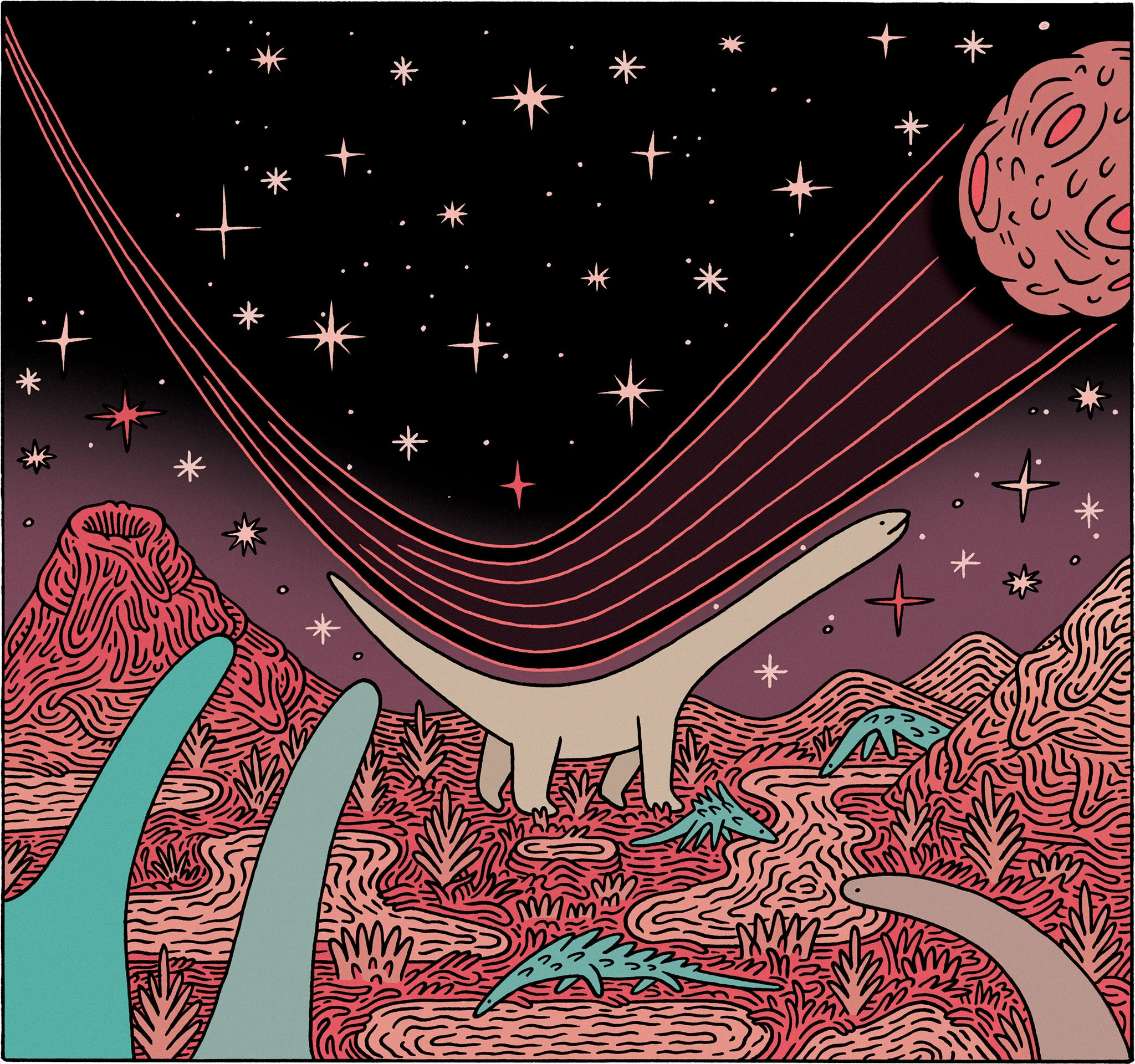
The upshot, Randall believes, is that dark matter could have finished off the dinosaurs 66 million years ago.
If it sounds a little like a tottering house of cards, the flipside is that cold, hard data is in the offing. Launched in 2013, the Gaia satellite allows the distance and motion of more than a billion stars in the galaxy to be determined with unprecedented accuracy.
“Gaia is a big camera that keeps repeatedly imaging the sky,” says Gilmore, who is a lead researcher on the mission. “If you measure [a star’s] apparent motion across the sky and you know the distance you can turn that into a real speed – how many kilometres a second that star is moving.” If a disc of dark matter exists, it could be detected by its influence on the motion of stars, in particular their vertical velocity. And we could soon have answers. “Over the next 10 years we are going to learn a great deal about how dark matter is distributed from Gaia and we are probably going to detect it in the Large Hadron Collider,” he says confidently.
Gaia and the LHC aren’t the only endeavours that could shed light on dark matter. Among other approaches, China’s recently launched Dark Matter Particle Explorer is set to study the phenomena while Euclid – a new mission from Nasa and Esa set to launch in 2020 – will be designed to explore both dark matter and dark energy.
Yet despite an enthusiastic hunt, the response from the academic community towards the ramifications of a dark matter disc on the dinosaurs has been equivocal. Gilmore is unconvinced by the link while Coryn Bailer-Jones from the Max Planck Institute for Astronomy in Germany – a critic of the paper when it appeared – says he has yet to change his mind. “I remain rather sceptical. I see, from the methodological point of view, serious issues.”
Among his concerns, he says, is the very low “likelihood ratio” reported in the 2014 paper – essentially a measure of how likely the theory is to yield current data compared to a model that assumes the rate of meteoroid impacts is uniform. He also says it is tricky to tell apart craters produced by objects hurled from the Oort cloud and those produced by rocks hailing from the asteroid belt. What’s more, “for me the whole thing about periodicity and cratering is kind of dead,” he says. But as Randall herself points out, she is fully aware of the speculative nature of the theory. “We said this is a question mark thing – let’s figure out if we can make this into science.”
Some scientists have even gone further. Professor Michael Rampino, a geologist at New York University who has long been a proponent of the idea that the solar system’s movement through the galactic midplane is linked to a periodicity in impact crater formation on Earth, has recently suggested that clumps might exist within the ‘dark disc’ - and that these could accumulate in the Earth’s core as our solar system passes through the disc. This, he says, could trigger a host of dramatic events, from volcanic activity to sea level changes. “As you pass through the [galactic] plane not only do you get the impacts/mass extinction story you might get this geological story where the geological activity of the earth is actually pulsing with the same period,” he explains when I call, pointing out that the theory could help to explain the much discussed link between impacts and other events thought to contribute to mass extinctions. It sounds extraordinary, but Rampino is remarkably gung-ho about objections. “I am never bothered about controversy, the more controversy the better,” he booms happily down the phone.
His enthusiasm for Randall’s theory is not, however, reciprocated. “It’s interesting to look for more connections and we appreciate his following our work. But this idea doesn’t work I’m afraid,” she shoots back when I quiz her by email. “He needs very dense dark matter to have a sufficient effect so he wants it in small dense objects. But they would be so small and dense that given the net amount of dark matter, there wouldn’t be enough to have significant probability of one passing through the Earth.” Fairbairn is also non-plussed while Bailer-Jones takes a moment to phrase his response. After a long pause, apparently searching for the right words, he settles on “It seems to be a bit of a what-if story.”
Back in Cambridge MA, Randall is refreshingly detached about the debate her theory has provoked. “I think astrophysicists are rather conservative, as scientists should be in some ways, but sometimes you can be so conservative that you are missing things.”
Ultimately, she later says, she isn’t out to push a particular idea, viable though she believes it to be. “Do I want to be working on something that turns out to be the wrong path for the rest of my life? No – I’d rather find out the answer,” she says.
Indeed, although Randall admits to enjoying rock climbing, skiing and hiking, it is hunting for the truth, however peculiar and mind-bending that might be, that is her true passion. Which brings us on to a topic that has been lurking in the background throughout our interview: women in science. Randall is, after all, a pioneer – the first tenured female theoretical physicist at MIT (Massachusetts Institute of Technology), the first tenured female professor of physics at Princeton and, now, the first tenured female professor of theoretical physics at Harvard, her alma mater. She is, however, reluctant to talk about it. Last month she almost refused an interview with the Huffington Post in protest at its desire to talk about her gender. “There will be times [when] I’ll have a five-minute interview to explain branes and [for] three minutes I have to explain being a woman in science,” she fumes when I venture into the area. “And I think this is not fair – if I was a guy I wouldn’t have to do that.”